


Chronology of Thomas Jefferson's Opposition to Slavery
1723 | "No negro, mullatto, or indian slaves, shall be set free, upon any pretence whatsoever, except for some meritorious services"
April 13, 1743 | Thomas Jefferson was born at Shadwell Virginia
1745 | At two years old, one of Jefferson’s earliest memories is of being handed up to a slave on horseback and carried on a pillow
June 10, 1751 | "Slaves freed without legal licence, may be sold by the churchwardens"
1752 | The colonists in the Virginia House of Burgesses attempted to stop or limit the importation of slaves into the colony by attaching a duty to their importation. The Act was renewed in 1754, 1759, 1766, 1769.
Journals of the House of Burgesses, 1766-1769, p. 39. Courtesy the Hathi Trust.
December 7, 1766, Journals of the House of Burgesses, 1766-1769, p. 47.
1757 | At 14 years old, Thomas Jefferson inherited 35 slaves from his father, Peter Jefferson although they did not become legally his until he was 21 in 1764.
April, 1757 | Virginia’s slave inheritance laws were tightened by the House of Burgesses in favor of creditors, making it difficult to manumit them..
September, 1758 | Virginia’s slave inheritance laws were again tightened by the House of Burgesses in favor of creditors.
“I. WHEREAS many frauds have been committed by means of secret gifts made, or pretended to have been made, of slaves, by parents and others, who have notwithstanding remained in possession of such slaves as visible owners thereof, whereby creditors and purchsers have been frequently involved in expensive lawsuits, and often deprived of their just debts & purchases:
For prevention whereof, Be it enacted, by the Lieutenant Governor, Council and Burgesses, of this present General Assembly, and it is hereby enacted, by the authority of the same, That from and after the passing of this act no gift of any slave or slaves shall be good or sufficient to pass any estate in such slave or slaves to any person or persons whatsoever, unless the same be made by will duly proved and recorded, or by deed in writing, to be proved by two witnesses at the least, or acknowledged by the donor, and recorded in the general court, or the court of the county where one of the parties lives, within eight months after the date of such deed or
writing.”
Hening, William Waller: The statutes at large; being a collection of all the laws of Virginia, from the first session of the legislature, in the year 1619. Published pursuant to an act of the General assembly of Virginia, passed on the fifth day of February one thousand eight hundred and eight, vol. 7, page 237. Richmond, Printed by and for Samuel Pleasants,1809-23. Courtesy The Hathi Trust.
1760's | Slave uprisings in the Virginia counties of Loudon, Fairfax, Frederick, Stafford, and Hanover increased the Virginia colonists' fear of a slave insurrection
1767 | Jefferson was admitted to the bar and began practicing law
1767+ | "Jefferson declined fees whenever cases came his way that would have established the freedom of persons their masters claimed were slaves"
February 24, 1768 | Jefferson accepted at no charge, a slave’s suit for freedom in Whitehead v. Belsches.
1769 | Jefferson’s first attempt at confronting the institution of slavery was a bill he drafted for the Virginia House of Burgesses proposing the manumission of slaves, "I made one effort in that body for the permission of the emancipation of slaves, which was rejected."
He later wrote in his autobiography, “In 1769, I became a member of the legislature by the choice of the county in which I live, & continued in that until it was closed by the revolution. I made one effort in that body for the permission of the emancipation of slaves, which was rejected: and indeed, during the regal government, nothing liberal could expect success. Our minds were circumscribed within narrow limits by an habitual belief that it was our duty to be subordinate to the mother country in all matters of government, to direct all our labors in subservience to her interests, and even to observe a bigoted intolerance for all religions but hers. The difficulties with our representatives were of habit and despair, not of reflection & conviction. Experience soon proved that they could bring their minds to rights on the first summons of their attention. But the king’s council, which acted as another house of legislature, held their places at will & were in most humble obedience to that will: the Governor too, who had a negative on our laws held by the same tenure, & with still greater devotedness to it: and last of all the Royal negative closed the last door to every hope of amelioration.”-Autobiography, January 6, 1821.–Founders Online, National Archives. Original source, The Papers of Thomas Jefferson, Retirement Series[/descriptionmore]
August 25, 1814 (relevant to 1769) | Jefferson blamed the unwillingness of his relatives and neighbors to ban slavery as well as other forms of bigotry and intolerance on the British and an older generation
The entrenched habits of an older generation were also culpable: “From those of the former generation who were in the fullness of age when I came into the public life…I soon saw that nothing was to be hoped. Nursed and educated in the daily habit of seeing the degraded condition, both bodily and mental, of those unfortunate beings, not reflecting that their degradation was very much the work of themselves and their fathers, few minds have but yet doubted that but that they were as legitimate subjects of property as their horses and cattle.”-Thomas Jefferson to Edward Coles, 25 August 1814, Founders Online, National Archives, http://founders.archives.gov
1769 | Jefferson hired Isaac Jackson from his owner until he became free. Then paid him for five more years.
October 18, 1769 | Jefferson agreed to take the case of Samuel Howell, a mulatto servant suing for his freedom (one month after his attempt to legalize emancipation in Virginia).
November 15, 1769 | The House of Burgesses passed an act that included " more effectual punishing Conspiracies and Insurrectsions" of slaves, indicating that fear of insurrection was a concern, and had been a concern of the colonists since at least 1749.
November 24, 1769 | Compensation was approved for the militia that was sent to "suppress and take some Negroes who it was suspected had assembled and designed an Insurrection".
Journals of the House of Burgesses of Virginia, 1765-1769; ed. by John Pendleton Kennedy. P. 286. Courtesy The Hathi Trust.
December 15, 1769 | Jefferson took out a writ at his own expense or pro bono in order to "bring suit on behalf of Samuel Howell, a servant (v. Netherland) in the General Court."
January 30, 1770 | Benjamin Franklin elucidates British obstruction of the colonists' repeated attempts to end slavery. "several Laws heretofore made in our Colonies, to discourage the Importation of Slaves, by laying a heavy Duty, payable by the Importer, have been disapproved and repealed by your Government.""several Laws heretofore made in our Colonies, to discourage the Importation of Slaves, by laying a heavy Duty, payable by the Importer, have been disapproved and repealed by your Government."
February 12, 1770 | Jefferson continued litigation at no charge on behalf of Ben Whitehead, a slave seeking freedom (see also Feb. 24, 1768)
March 31, 1770 | Jefferson identified a witness for Samuel Howell.
April, 1770 | Howell’s case came to trial and Thomas Jefferson openly declared his opposition to slavery when he argued that "all men are born free" in defense of a mulatto servant.
April, 1770 | The reaction of the court to Jefferson’s eloquent plea for Howell’s freedom was immediate, derisive and dismissive. Jefferson’s mentor, George "Wythe, for the defendant, was about to answer, but the court interrupted him and gave judgment in favor of his client". Jefferson was 27 years old and ejected by a court that considered it absurd to challenge the laws of slavery on larger, natural law principals such as, “all men are born free”.
May 3, 1770 | Jefferson gave money to Howell, who had just lost his freedom suit. It has been speculated that it was Jefferson's intention and that Howell used the money to run away.
May 14, 1770 | Jefferson entered his defeat in the case of Howell vs. Netherland in his memorandum book, "Howell v. Netherland. Judgmt for def."
May 28, 1770 | The House of Burgesses considered a petitions regarding compensation for slaves killed in an insurrection and the guns used against them.
“The Petition for the Allowance for the Guns which were used in suppressing a late Insurrection of the Slaves of Bowler Cocke, and spoiled, is reasonable; (p. 100). Journals of the House of Burgesses of Virginia, 1770-1772, edited by John Pendleton Kennedy, The Colonial Press, E. Waddey Co., 1906. Courtesy the Hathi Trust
June 20, 1770 | Jefferson filed suit against his brother Randolph’s overseer, Isaac Bates who had, "by a cruel whipping killed a negro woman Hanah".
Dec. 27: Jefferson v. Bates. Atta. Inclosd. to sher. Buckinghm. (p. 200)”
“John Nicholas (1725?-1795) was clerk of Albemarle County from 1749 to 1792 and was one of PJ’s executors. He lived at Seven Islands on the James River in northeast Buckingham County (V. Dennis Golladay, “The Nicholas Family and Albemarle County Political Leadership, 1782-1790,” MACH, xxxv/xxxvi [1977/1978], 125). The defendant Isaac Bates, overseer for RJ, had “by a cruel whipping killed a negro woman Hanah.” With Nicholas’ approbation TJ brought suit as his brother’s “next friend” (Case Book, No. 433). Thomas Jefferson’s “Case Book, 1767-1774,” 192 bound quarto leaves containing records of 939 cases. Indexed. CSmH description ends ).”
Footnote, Memorandum Books Vol. I page 177.
Memorandum Books, 1770,” Founders Online, National Archives, last modified December 28, 2016, http://founders.archives.gov/documents/Jefferson/02-01-02-0004. [Original source: The Papers of Thomas Jefferson, Second Series, Jefferson’s Memorandum Books, vol. 1, ed. James A Bear, Jr. and Lucia C. Stanton. Princeton: Princeton University Press, 1997, pp. 154–213.]
June 22, 1770 | The House of Burgesses granted compensation to Bowler Cocke for the slaves killed and wounded in an insurrection.
Journals of the House of Burgesses of Virginia, 1770-1772; ed. by John Pendleton Kennedy. P. 92. Courtesy the Hathi Trust.
June 22, 1770 | Jefferson signed another nonimportation resolution that stated, " Fourthly. That we will not import or bring into the colony, or cause to be imported or brought into the colony, either by sea or land, any slaves, or make sale of any upon commission, or purchase any slave or slaves that may be imported by others after the 1st day of November next, unless the same have been twelve months upon the continent".
December 6, 1770 | Jefferson took the case of an enslaved man, Ned Russell, at no charge.
Prior to 1772 | The Virginia Assembly presented at least 33 different acts to discourage the slave trade, prior to 1772.
“No colony made a more strenuous and prolonged effort to prevent the imposition of negro slavery upon it, and no State a more earnest attempt to alleviate or rid itself of that burden than Virginia. Both efforts failed from inexorable political and economic conditions over which the Virginians had but little control. The sincerity of their desire is, however, evinced from the extreme measures resorted to to gain their end. The colonists justified themselves, in view of the unjust methods of the Mother Country, in employing the arts of diplomatic deceptions, and political pressure, whenever emergencies arose that gave them an advantage. When such means failed they resorted to humble pleading and finally to outspoken condemnation of the English policy and to threatened rebellion.
By skillful wording of preambles and brief limitations to the acts imposing duties, and by judicious expenditure upon public works of the revenue raised, the colonists had partially concealed the the true intent of the acts during the first ten years. The Assembly of 1710 became bolder, and pressed by the exigencies fo the growning over-production and low prices of tobacco and by the general indebtedness for the increasing purchases of negroes, advanced the duty on negro slaves to £5, while it left the tariff on liquors and on Indians as before. Governor Spotswood was not slow to see that the design was to discourage the importation of negro slaves, and he remonstrated with the members of the Assembly, urging them to abandon the bill or to lower the duty. The arguments of the colonists, however, were unanswerable, and the Assembly finally refused to yield. As Spots wood was unwilling to oppose “the general inclination of the country: he allowed the act to pass and made apologies to the authorities in England as he hoped would prevent opposition from the slave traders. He alleged that the planters were practically bankrupt and could not or would not purchase any slaves until the price of tobacco imporved which was not reasonably to be expected within the three years of limitation of the act.
This high duty was continued by two other acts, 1712 and 1714, until the year 1718. Spotswood allowed these also to pass. He explained that they were necessary to keep up public credit and to pay the debts “already contracted;” but it is evident that his statement was made in fear that their provisions might prove disagreeable to England.25 It was quickly shown that his fear was well grounded, but the objections raised in England were not serious enough to withstand the arguments of Spotswood backed by the actual benefits the colony could show for her judicious expenditure of the large revenue raised.26 From 1718 until 1723, for some reason that does not fully appear, a duty was not collected. It would seem from a remark of Thomas Jefferson’s that the Assembly was either careless or was influenced by some peculiar circumstance—probably pressure from England—that demanded the repeal of the duty. At any rate, this”inconsiderate” action, as Jefferson termed it, met with a “joyful sanction” from the English Crown, which from that
time forth resented all attempts to renew a duty.” (pages 14-16)
Ballagh, James Curtis, A History of Slavery in Virignia, The Johns Hopkins Press, Baltimore, 1902, pages 11-14.
Relevant | Jefferson later divulged that the Colonists had attempted to stop the importation of slaves, and that the new Virginia legislature had succeeded in their attempts. He hoped this would lead to total emancipation.
Under the mild treatment our slaves experience, and their wholesome, though coarse, food, this blot in our country increases as fast, or faster, than the whites. During the regal government, we had at one time obtained a law, which imposed such a duty on the importation of slaves, as amounted nearly to a prohibition, when one inconsiderate assembly, placed under a peculiarity of circumstance, repealed the law. This repeal met a joyful sanction from the then sovereign, and no devices, no expedients, which could ever after be attempted by subsequent assemblies, and they seldom met without attempting them, could succeed in getting the royal assent to a renewal of the duty. In the very first session held under the republican government, the assembly passed a law for the perpetual prohibition of the importation of slaves. This will in some measure stop the increase of this great political and moral evil, while the minds of our citizens may be ripening for a complete emancipation of human nature.
Jefferson, Thomas: Notes on the State of Virginia. Philadelphia, H.C. Carey & I Lea, 1825, page 124.
March 12, 1772 | In an effort to restrict the importation of slaves, the Virginia House of Burgesses revived a duty on them. "An Act for continuing and amending several Acts, for laying Duties upon Slaves imported".
Journals of the House of Burgesses of Virginia, 1770-1772; ed. by John Pendleton Kennedy. P. 263
April, 1772 | Jefferson noted that in the revisal of a 1748 law, "an alteration of a few words indeed, but of most extensive barbarity. It has subjected to slavery the free inhabitants of the two continents of Asia and Africa".
servants imported,’ substitutes ‘all persons who have been or shall be imported; an alteration of few words indeed, but of most extensive barbarity. It has subjected to slavery the free inhabitants of the two continents of Asia and Africa (except of .the small parts of them inhabited by Turks and Moors in amity with England) and also the Aborigines of North and South America, unless Mason’s observation on the word ‘shipped,’ shall be thought to avail them. It even makes slaves of the Jews who shall come from those coun- tries, on whose religion ours is engrafted, and so far as it goes, supposes it to be founded on perfect verity. Nay, it extends not only to such of those persons as should come here after the act, but also to those who had come before, and might then be living here in a state of freedom.”
Jefferson, Thomas: Reports of Cases Determined in the General Court of Virginia from 1730 to 1740; and from 1768 to 1772, F. Carr, and Co., Charlottesville, 1829, pages 112-113.
April 1, 1772 | The Virginia House of Burgesses, where Jefferson served from 1769 to 1774, petitioned King George III to end the slave trade.
We, your Majesty’s dutiful and loyal Subjects, the Burgesses of Virginia, now met in General Assembly, beg Leave, with all Humility, to approach your Royal Presence. The many Instances of your Majesty’s benevolent Intentions and most gracious Disposition to promote the Prosperity and Happiness of your Subjects in the Colonies encourage us to look up to the Throne, and implore your Majest’ys paternal Assistance in averting a Calamity of a most alarming Nature.
The importation of Slaves into the Colonies from the Coast of Africa hath long been considered as a Trade of great Inhumanity, and under its present Encouragement we have too much Reason to fear will endanger the very Existance of your Majesty’s American Dominions.
We are sensible that some of your Majesty’s Subjects in Great-Britain may reap Emoluments from this Sort of Traffic, but when we consider that it greatly retards the Settlement of the Colonies, with more useful Inhabitants, and may, in Time, have the most destructive Influence, we presume to hope that the Interest of a few will be disregarded when placed in Competition with the Security and Happiness of such Numbers of your Majesty’s dutiful and loyal Subjects.
Deeply impressed with these Sentiments, we most humbly beseech your Majesty to remove all those Restraints on your Majesty’s Governors of this Colony, which inhibit their assenting to such Laws as might check so very pernicious a Commerce.
Your Majesty’s antient Colony and Dominion of Virginia hath, at all Times, and upon every Occasion, been entirely devote to your Majesty’s sacred Person and Government, and we cannot forego this Opportunity of renewing those Assurances of the truest Loyalty, and warmest Affection, which we have so often with the greatest Sincerity, give to the best of Kings, whose Wisdom and Goodness we esteem the surest Pledges of the Happiness of all his People.”
Journals of the House of Burgesses of Virginia, 1770-1772; ed. by John Pendleton Kennedy. P. 284
April 12, 1772 | "An Act directing the Trial of Slaves, committing capital Offences, and for the more effectual punishing Conspiracies and Insurrections of them, and for the better Government of Negroes, Mulattoes, and Indians, bond or free", was passed.
Title of the Act as passed: “An Act for amending the Acts concerning the Trials and Outlawries of Slaves.”
Indicates that insurrection was a valid fear of the colonists.
Journals of the House of Burgesses of Virginia, 1770-1772; ed. by John Pendleton Kennedy. P. 307. Courtesy the Hathi Trust.
September 10, 1772 | Jefferson undertook the freedom suit of an enslaved woman, Sybil, "Charge no fee".
November 1,1772 | "Bring suit for freedom." Jefferson files another freedom suit on behalf of Isaac.
November 3, 1772 | Jefferson took out the writ for Isaac’s freedom suit.
February 7, 1773 | Jefferson secured the freedom of George Manly "Verdict and jdmt for £50 and costs in October
1773 | Jefferson employed George Manly, now a free man of color, for two years.
November 11, 1773 | Jefferson filed suit in the case of Jamey (a slave) v. Brown.
1773 | At the age of 30, Jefferson inherited 135 slaves from his father-in-law, John Wayles, that were all encumbered by debt to British creditors.
Before 1774 | James Madison wrote, " It is well known that during the Colonial dependence of Virga. repeated attempts were made to stop the importations of slaves".
From James Madison to Robert Walsh Jr., 2 March 1819,” Founders Online, National Archives, last modified June 29, 2017,. [Original source: The Papers of James Madison, Retirement Series, vol. 1, 4 March 1817 – 31 January 1820, ed. David B. Mattern, J. C. A. Stagg, Mary Parke Johnson, and Anne Mandeville Colony. Charlottesville: University of Virginia Press, 2009, pp. 427–432.]
July, 1774 | Jefferson wrote, "The abolition of domestic slavery is the great object of desire
‘The abolition of domestic slavery is the great object of desire in those colonies where it was unhappily introduced in their infant state. But previous to the infranchisement of the slaves we have, it is necessary to exclude all further importations from Africa. Yet our repeated attempts to effect this by prohibitions, and by imposing duties which might amount to a prohibition, have been hitherto defeated by his majesty’s negative: thus preferring the immediate advantages of a few British corsairs to the lasting interests of the American states, and to the rights of human nature deeply wounded by this infamous practice. Nay the single interposition of an interested individual against a law was scarcely ever known to fail of success, tho’ in the opposite scale were placed the interests of a whole country. That this is so shameful an abuse of a power trusted with his majesty for other purposes, as if not reformed would call for some legal restrictions.”–Founders Online, National Archives. Original source: The Papers of Thomas Jefferson, vol. 1, 1760–1776, ed. Julian P. Boyd. Princeton: Princeton University Press, 1950, pp. 121-137.
July, 1774 | Jefferson recognized that prior to the incorporation of freed slaves into society, the slave trade must be abolished. Note that colonization is not a consideration at this point.
July, 1774 | Jefferson’s Instructions to the Delegates were re-published without his knowledge as, A Summary View of the Rights of British America.
November 26, 1774 | James Madison voiced the colonists’ fears of a slave insurrection, in this case, instigated by the British. A minor insurrection was suppressed.
January 4, 1775 | William Bradford confirmed Madison’s fear of insurrection.
March 24, 1775 | lans were made by the Committee to Prepare a Plan for a Militia, of which Jefferson was a member, to form a militia in case of invasion or insurrection.
April 12-19, 1775 | "At least 6 incidents of presumed slave unrest in Virginia."
April 21, 1775 | Lord Dunmore confiscated the colonists’ gunpowder at Williamsburg, leaving them defenseless against rebellious slaves and threatened to "declare freedom to the slaves and reduce the City of Williamsburg to ashes".
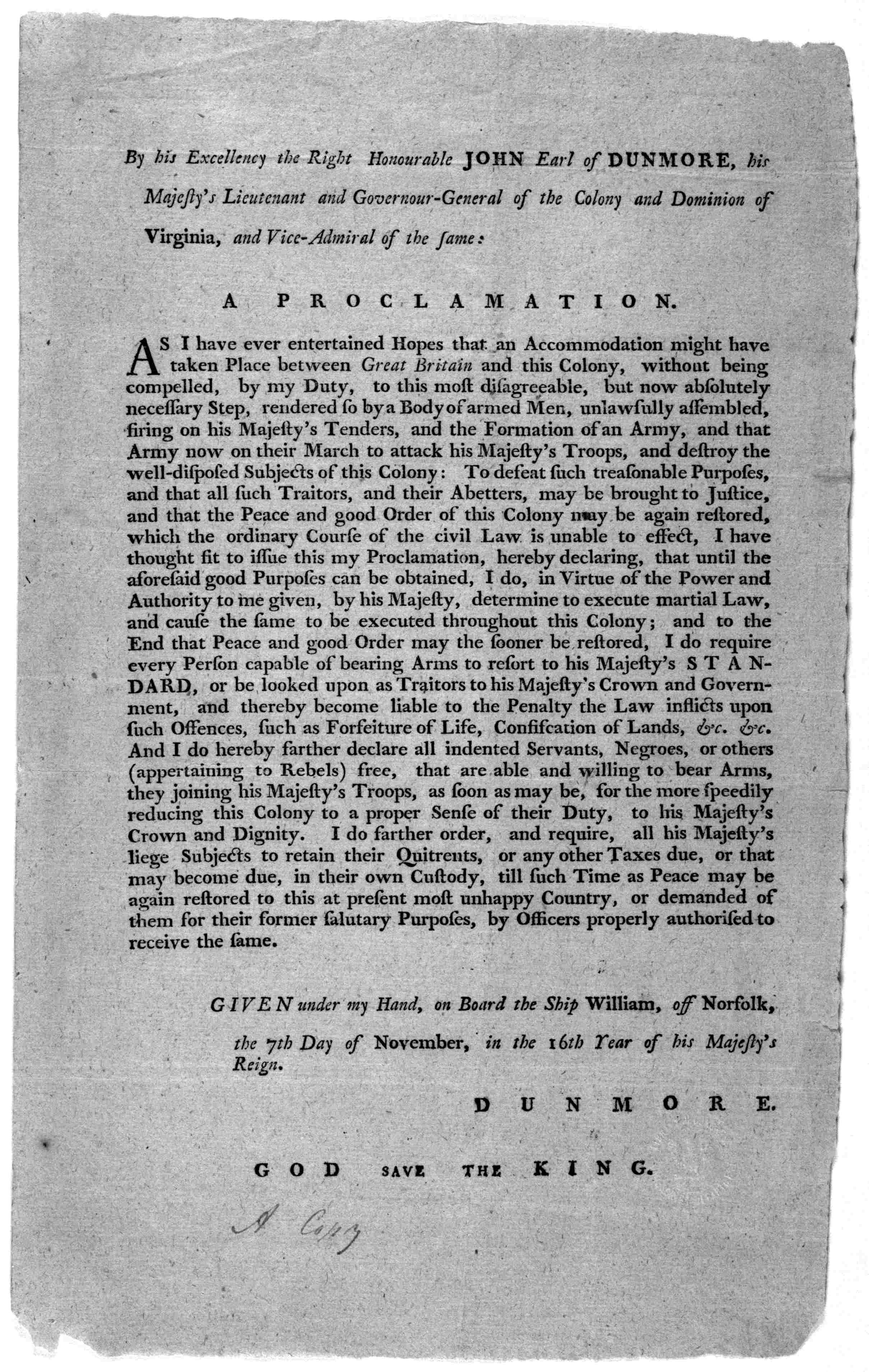
Courtesy the Library of Congress, www.loc.gov
Before June, 1776 | Jefferson’s first and third drafts of a Virginia Constitution condemned the British slave trade and incitement of the slaves against the Colonists.
Before June, 1776 | Astonishingly, soon after Lord Dunsmore’s Proclamation terrified the Virginians, Jefferson called for total emancipation in his second and third drafts of the a Virginia Constitution and condemned slavery in the Declaration.
Before June, 1776 | Jefferson’s second and third drafts of a Virginia Constitution called for an end to slavery, "under any pretext whatever".
June 29, 1776 | Jefferson’s draft arrived late to the Virginia Constitutional convention and George Mason’s version was adopted without Jefferson’s slavery clause having been discussed.
July 27, 1776 | George Wythe informed Jefferson that although Mason’s Virginia constitution had been accepted, non-controversial parts of Jefferson’s draft, that arrived late, were included.
April 3, 1825 (relevant to June, 1776) | Jefferson explained that the debates over the Virginia Constitution had exhausted the delegates and the more pretentious issues such as abolishing slavery were abandoned.
June 11-July 4, 1776 | Jefferson lists the King’s refusal to end the slave trade and the arming of African Americans against the Colonists as one of the reasons to declare independence.
June 11-July 4, 1776 | In his draft of the Declaration of Independence, Jefferson called the slave trade an "assemblage of horrors,
June 7-August 1, 1776 | Jefferson explained why the passages in the Declaration of Independence condemning slavery and the slave trade were struck from the final document.
July 12-August 1, 1776 | Jefferson described the debate regarding slaves at the Continental Congress.
May, 1777 | Virginia passed a law that Jefferson was instrumental in drafting, obligating him to accept the continental currency issued by Congress for the sale of the Wayle’s lands. This paper currency depreciated to nearly zero during the Revolutionary War, making his efforts to clear his debt futile ultimately affecting his ability to free his slaves upon his death as George Washington had.
June 16, 1777 | Jefferson's "Bill to prevent slavery and the importation of slaves" was enacted in 1778 without Jefferson's clause making slavery illegal.
October 1777 | The Virginia Commonwealth enacted a law that called for those indebted to British subjects before the war to deposit their payments in the Virginia treasury. A like sum would be paid to the creditor after the war.
After October, 1777 | Accordingly, Jefferson deposited in the Virginia treasury, the full payment of his debt to Jones from the Wayles estate of £4200, in the paper money that he was required by Colonial law to accept from those he sold his share of the Wayles land in order to discharge his debt. The paper money devalued and the Treaty of Paris stated that pre-war debts must be paid in sterling. Jefferson assumed the loss and repaid the debt.
Another question is as to the paper money I deposited in the treasury of Virginia towards the discharge of this debt. I before observed that I had sold lands to the amount of 4200£ before a shilling of paper money was emitted, with a view to pay this debt. I received this money in depreciated paper. The state was then calling on those who owed money to British subjects to bring it into the treasury, engaging to pay a like sum to the creditor at the end of the war. I carried the identical money therefore to the treasury, where it was applied, as all the money of the same description was to the support of the war. Subsequent events have been such that the state cannot, and ought not to pay the same nominal sum in gold or silver which they received in paper, nor is it certain what they will do. My intention being, and having always been, that, whatever the state decides, you shall receive my part of your debt fully, I am ready to remove all difficulty arising from this deposit, to take back to myself the demand against the state, and to consider the deposit as originally made for myself and not for you.
From Thomas Jefferson to William Jones, 5 January 1787,” Founders Online, National Archives, last modified June 29, 2017. [Original source: The Papers of Thomas Jefferson, vol. 11, 1 January–6 August 1787, ed. Julian
October 5, 1778 | "An Act for preventing the farther importation of slaves" was signed into law without Jefferson’s clause making slavery illegal.
1778 (written in 1821) | Jefferson wrote that the bill, "stopped the increase of the evil by importation, leaving to future efforts it’s final eradication", indicating he fully expected slavery to be eradicated.
June 1-5, 1779 | Jefferson's "Catalogue of Bills Prepared by the Committee of Revisors" lists number 51, "Concerning Slaves".
June 18, 1779 | As a member of the Revisors Committee, Jefferson nearly single-handedly, re-wrote the entire code of laws for Virginia including, along with George Wythe, "A Bill Concerning Slaves", that banned their importation.
June 18, 1779 | Bill 51 originally had a clause calling for a gradual but full emancipation of the slaves but it was held back as an amendment to be proposed later. Jefferson was absent in Paris but explained what happened–see June 26, 1786.
June 18, 1779 | Jefferson advocated for the elementary education of "free" children, without specifying race, for 3 years at public expense in his Bill for the More General Diffusion of Knowledge.
From the Editors of The Papers of Thomas Jefferson, Princeton University Press:
“TJ apparently finished the Bill late in the autumn of 1778, for on 18 Dec. 1778 he wrote to Pendleton about it (his letter is missing, but see Pendleton’s reply under date of 11 May 1779). On 15 Dec. 1778 leave was given by the House for the presentation of a Bill “for the more general diffusion of knowledge,” and Richard Parker and George Mason were ordered to prepare it; the Bill was presented by Parker on the next day, whereupon the House “Ordered, That the public printer do forthwith print and forward four copies of the said act to each county within this Commonwealth” (JHD, Oct. 1778, 1827 edn., p. 117, 120). It is very doubtful whether this order to print the Bill was actually executed; if it was, no copy of it has been found (see Edmund Pendleton to TJ, 11 May 1779 and notes thereon). The Bill was again presented on 12 June 1780, but no further action was taken until, on 31 Oct. 1785, Madison brought it up along with other bills of the Report of the Committee of Revisors. It was considered by the House 6 Dec., was amended 20 Dec., and on 21 Dec. was actually passed by the House under a new title, “An act, directing the mode of appointing aldermen.” But, on being referred to the Senate, the Bill died (JHD, May 1780, 1827 edn., p. 14, 44; same, Oct. 1785, 1828 edn., p. 12–15, 74–5, 100, 101). Madison reported a year later, when TJ’s Bill was again considered, that the system was carefully considered but not adopted because of the cost involved (Madison to TJ, 4 Dec. 1786; see also Madison to TJ, 22 Jan. 1786).
Madison did not bring in Bill No. 79 with the others reported on 1 Nov. 1786 but it was brought up two weeks later, and, as Madison reported to TJ, it “went through two readings by a small majority and was not pushed to a third one” (Madison to TJ, 15 Feb. 1787; JHD, Oct. 1786, 1828 edn., p. 44). The plan for establishing public schools was not carried to completion until 1796 when the Assembly passed an “Act to Establish Public Schools” (Shepherd, ii, 3–5) which retained some of the phraseology of TJ’s Bill, especially that providing for the election of aldermen. However, the 1796 Act provided only for primary schools, and the determination of the expediency of establishing such schools was left entirely to the aldermen of each county, borough, or corporation.”
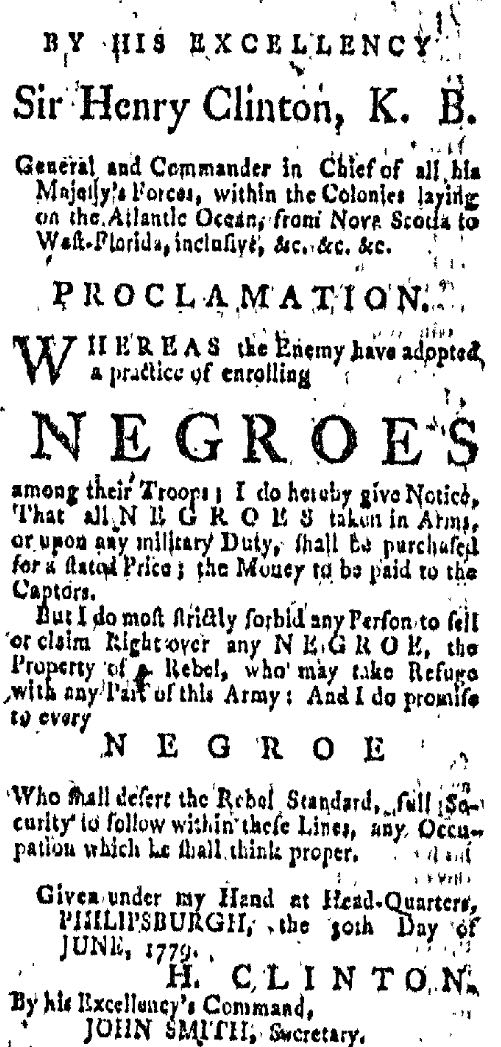
June 30, 1779 | "British General Sir Henry Clinton issued the Philipsburg Proclamation, freeing slaves belonging to rebellious colonists, increasing the colonists’ hostility toward emancipation and dampening the spirit of the Revolution".
September 6, 1780 | The Continental Congress requested a liberal cession of land from the existing states for the common benefit of the Union.
Journals of Congress, March 4, 1784, vol. 26, page 113. Courtesy the Library of Congress, www.loc.gov.
1781 | Jefferson wrote Notes on the State of Virginia in response to questions posed to him by Francois Barbe-Marbois, secretary to the French Ambassador. It contains some of the most eloquent denunciations of slavery ever written, as well as a plan for gradual, compensated emancipation. Jefferson not only condemned slavery but predicted a future civil war if the evil was not eradicated.
1781 | Initially, Jefferson did not want Notes published as he suspected that they might harm the cause of emancipation (see May 11-September 2, 1785)
1781 | When asked about the manners of his countrymen in Query XIII, Jefferson responded they had been unhappily influenced by the existence of slavery and continued with a ringing indictment of the evil.
1781 | Query XIII: "There must doubtless be an unhappy influence on the manners of our people produced by the existence of slavery among us. The whole commerce between master and slave is a perpetual exercise of the most boisterous passions, the most unremitting despotism on the one part, and degrading submissions on the other. Our children see this, and learn to imitate it; for man is an imitative animal."
1781 | Query XIII: "...these liberties are of the gift of God? That they are not to be violated but with his wrath?Indeed I tremble for my country when I reflect that God is just: that his justice cannot sleep for ever".
1781 | Query XIII: "The Almighty has no attribute which can take side with us in such a contest."
1781 | Query XIII: "I think a change already perceptible, since the origin of the present revolution. The spirit of the master is abating, that of the slave rising from the dust, his condition mollifying, the way I hope preparing, under the auspices of heaven, for a total emancipation, and that this is disposed, in the order of events, to be with the consent of the masters, rather than by their extirpation."
1781 | Query VIII: Jefferson divulged that the Colonists had attempted to stop the importation of slaves, and that the new Virginia legislature had succeeded in their attempts. He hoped this would lead to total emancipation.
1781 | Query VIII: "This will in some measure stop the increase of this great political and moral evil, while the minds of our citizens may be ripening for a complete emancipation of human nature".
1781 | Query XIV: Jefferson noted that one of the most remarkable alterations to Virginia law proposed by the Revisors was, "To emancipate all slaves born after passing the act
1781 | Query XIV: When asked to describe the population of Virginia, Jefferson included the slaves, but hazarded his observations as a "suspicion only…lest they degrade an entire race".
May 13, 1781 | Two judges in the case of Billy, a slave accused of treason for joining the British, argued for a reprieve from Governor Jefferson on the grounds that Billy could not commit treason as he was not a citizen.
May, 1781 | As Governor of Virginia, Jefferson granted a stay of execution to Billy, a slave accused of treason, making his eventual pardon possible.
June, 1781 | Cornwallis destroyed Jefferson's crops and lievestock and carried off 30 of Jefferson's slaves. "Had this been to give them freedom he would have done right, but it was to consign them to...death from the small pox."
January 27, 1783 | Jefferson's "Statement of Losses to the British" in 1781 at his Cumberland holdings included slaves who later died from camp fever.
1783 | By this time, Jefferson had failed to ease the terms of emancipation in the House of Burgesses, and to end slavery in the 1776 Virginia Constitution, in the Declaration of Independence, and on the Virginia Revisors Committee, yet again we see his attempt to end slavery through permanent, legal mechanisms in a new constitution for Virginia.
May-June 1783 | Jefferson suggested a new constitution for Virginia that included the gradual emancipation of slaves. It would have resulted in the abolition of slavery in that state. "All persons born after that day being hereby declared free".
June 6, 1783 | Jefferson was selected to represent Virginia at the Continental Congress for one year.
June 17, 1783 | Jefferson asked Madison not to show his draft Constitution for Virginia to anyone from Virginia as "I have found prejudices frequently produced against propositions handed to the world without explanation or support".
September 3, 1783 | The Treaty of Paris was signed, ending the Revolutionary War. It was proclaimed on January 14, 1784.
October 20, 1783 | The general Assembly of Virginia authorized their delegates to the Continental Congress to convey their territory northwestward of the Ohio River.
January 14, 1784 | Article IV of the Treaty of Paris mandated that debts must be paid in sterling. Jefferson’s British creditors would not accept the worthless paper money he had received in payment for the Wayles’ lands, and paid into the Virginia treaury as per the Act of Oct. 1777, making him obligated for the debt a second time. making him obligated for the debt a second time.
March 1, 1784 | Pursuant to the recommendations made by Congress on September 6, 1780, and subsequent to actions taken by the Commonwealth of Virginia on January 2, 1781 and September 13, 1783, Virginia ceded "all of her territory, north of the Ohio River, to the United States".
March 1, 1784 | Thomas Jefferson, Jeremiah Chase and David Howell who were appointed to a committee to "prepare a plan for the temporary government of the western territory", presented their plan.
March 1, 1784 | Jefferson proposed that "there shall be neither slavery nor involuntary servitude
The Journals of the Continental Congress, Volume 26, p. 118. Courtesy the Library of Congress, www.loc.gov.
April 19, 1784 | Richard Spaight, a delegate from North Carolina to the Continental Congress, moved that Jefferson’s clause prohibiting slavery or involuntary servitude in the new states be struck from the plan to govern the new territories.
April 19, 1784 | A vote was taken, Jefferson’s effort to prohibit slavery failed by one vote, The clause was struck.
April 25, 1784 | Jefferson related the failure of the antislavery proviso to Madison, " The 2d. was lost by an individual vote only. Ten states were present. The 4. Eastern states, N. York, Pennsva. were for the clause. Jersey would have been for it, but there were but two members, one of whom was sick in his chambers. South Carolina Maryland, & ! Virginia ! voted against it. N. Carolina was divided as would have been Virginia had not one of its delegates been sick in bed".
1784 Editor's note | "Jefferson proposed to interdict slavery in all the western territory and not merely in the northwest territory as the Ordinance of 1787 did. Had it been adopted as Jefferson reported it, slavery would have died a natural death, and secession would have been impossible."
See footnote to Report of Government for the Western Territory: Thomas Jefferson, The Works of Thomas Jefferson, Federal Edition (New York and London, G.P. Putnam’s Sons, 1904-5). Vol. 4. 3/13/2017. Courtesy The Online Library of Liberty
1784-Editor's note | "This plan, with its limitation of slavery, though failing by only one vote of adoption in 1784, was unpopular at the South and increasingly so as slavery became more and more profitable and more and more a Southern institution. As early as 1790 Jefferson’s partizans were already his apologists for this document, and from that time Jefferson carefully avoided any public utterance on slavery".
See footnote to Report of Government for the Western Territory [March 22, 1784]: Thomas Jefferson, The Works of Thomas Jefferson, Federal Edition (New York and London, G.P. Putnam’s Sons, 1904-5). Vol. 4. 3/13/2017. Courtesy The Online Library of Liberty.
1784 Related quote | "Thus, with the author of the Declaration of Independence, the policy of prohibiting slavery in new territory originated".–Abraham Lincoln
Thus, with the author of the Declaration of Independence, the policy of prohibiting slavery in new territory originated. Thus, away back of the constitution, in the pure fresh, free breath of the revolution, the State of Virginia, and the National congress put that policy in practice. Thus through sixty odd of the best years of the republic did that policy steadily work to its great and beneficent end. And thus, in those five states, and five millions of free, enterprising people, we have before us the rich fruits of this policy
Lincoln, Abraham, Peoria Speech, October 16, 1854 from Collected Works of Abraham Lincoln, edited by Roy P. Basler. Courtesty The National Park Service, www.nps.gov
Author Comment | "There was nothing in the Articles of Federation that spoke to the abolition of slavery until this Ordinance".–Erik S. Root
Author comment | "Jefferson’s ordinance was designed to prevent the spread of slavery as a legal institution outside of the original states, and it would have made secession impracticable if not impossible. Only in the light of tragic history can the wisdom of his preventive measure be fully appreciated".–Dumas Malone
July 5, 1784 | Thomas Jefferson weighed anchor from Boston for France aboard the Ceres at 4:00 AM.
“From Thomas Jefferson to David Humphreys, 4 July [1784],” Founders Online, National Archives, last modified December 28, 2016, http://founders.archives.gov/documents/Jefferson/01-07-02-0275. [Original source: The Papers of Thomas Jefferson, vol. 7, 2 March 1784 – 25 February 1785, ed. Julian P. Boyd. Princeton: Princeton University Press, 1953, pp. 363–364.]See also, July 5 from:
“Memorandum Books, 1784,” Founders Online, National Archives, last modified December 28, 2016, http://founders.archives.gov/documents/Jefferson/02-01-02-0018. [Original source: The Papers of Thomas Jefferson, Second Series, Jefferson’s Memorandum Books, vol. 1, ed. James A Bear, Jr. and Lucia C. Stanton. Princeton: Princeton University Press, 1997, pp. 541–572.]
August 6, 1784 | Thomas Jefferson arrived in Paris.
“From Thomas Jefferson to David Humphreys, 4 July [1784],” Founders Online, National Archives, last modified December 28, 2016, http://founders.archives.gov/documents/Jefferson/01-07-02-0275. [Original source: The Papers of Thomas Jefferson, vol. 7, 2 March 1784 – 25 February 1785, ed. Julian P. Boyd. Princeton: Princeton University Press, 1953, pp. 363–364.]
March 10, 1785 | Congress appointed Thomas Jefferson as the United States Minister Plenipotentiary to France.
March 16, 1785 | The proposition preventing slavery in the new states was moved to a committee by Congress. Ever the optimist, Jefferson wrote, "I hope the friends of the natural rights of man will continue our efforts till they succeed
Pa. 280. ‘Et il est à desirer’ &c. On the 16th. of March 1785. it was moved in Congress that the proposition for preventing slavery in the new states should be referred to a committee, and it was accordingly referred by the vote of 8. states against 3 but I have not seen that any thing further has been done in it. I hope the friends of the natural rights of man will continue our efforts till they succeed.–Jefferson’s Observations on DeMeunier’s Manuscript, June 22, 1786. Founders Online, The National Archives. Original source: The Papers of Thomas Jefferson, vol. 10, 22 June–31 December 1786, ed. Julian P. Boyd. Princeton: Princeton University Press, 1954, pp. 30–61.
May 25, 1785 | Jefferson told Adams why he had delayed the publication of Notes on Virginia for two years, "I am happy if you find any thing in them worthy your approbation. but my country will probably estimate them differently".
May 11, 1785 | Jefferson hesitated to publish Notes on the State of Virginia, "there are sentiments on some subjects which I apprehend might be displeasing to the country perhaps to the assembly or to some who lead it".
June 7, 1785 | Again Jefferson is reticent to publish Notes, "these strictures might produce an irritation which would indispose the people towards the two great objects I have in view, that is the emancipation of their slaves, and the settlement of their constitution on a firmer and more permanent basis".
… I have supposed the blackman, in his present state, might not be so. But it would be hazardous to affirm that, equally cultivated for a few generations, he would not become so…”–Thomas Jefferson to Chastellux, June 7, 1785, Founders Online, The National Archives. Original source: The Papers of Thomas Jefferson, vol. 8, 25 February–31 October 1785, ed. Julian P. Boyd. Princeton: Princeton University Press, 1953, pp. 184–186.
June 7, 1785 | Jefferson began to look to the younger generation to abolish slavery after repeated attempts to convince his own generation, "It is to them I look, to the rising generation, and not to the one now in power for these great reformations".
–Thomas Jefferson to Chastellux, June 7, 1785, Founders Online, The National Archives. Original source: The Papers of Thomas Jefferson, vol. 8, 25 February–31 October 1785, ed. Julian P. Boyd. Princeton: Princeton University Press, 1953, pp. 184–186.
June 17, 1785 | Jefferson informed Monroe regarding the publication of Notes, "I have taken measures to prevent it's publication. My reason is that I fear the terms in which I speak of slavery and of our constitution may produce an irritation which will revolt the minds of our countrymen against reformation in these two articles, and thus do more harm than good".
June 21, 1785 | Jefferson once more expressed his fears of publishing Notes, "till I hear from my friends whether the terms in which I have spoken of slavery and of the constitution of our state will not, by producing an irritation, retard that reformation which I wish instead of promoting it".
Thomas Jefferson to Charles Thomson, Paris, June 21, 1785, Founders Online, The National Archives. Original source: The Papers of Thomas Jefferson, vol. 8, 25 February–31 October 1785, ed. Julian P. Boyd. Princeton: Princeton University Press, 1953, pp. 245–246.
August 7, 1785 | Jefferson encouraged Dr. Richard Price to release his pamphlet on the American Revolution especially as a means of influencing young Virginians against slavery and wished he would do more. It recommended measures for gradually abolishing slavery, "the sacred side is gaining daily recruits from the influx into office of young men grown and growing up. These have sucked in the principles of liberty as it were with their mother’s milk, and it is to them I look with anxiety to turn the fate of this question. Be not therefore discouraged. What you have written will do a great deal of good".
From Thomas Jefferson to Richard Price, 7 August 1785,” Founders Online, National Archives, last modified June 29, 2017. [Original source: The Papers of Thomas Jefferson, vol. 8, 25 February–31 October 1785, ed. Julian P. Boyd. Princeton: Princeton University Press, 1953, pp. 356–357.]
September 2, 1785 | Jefferson called the South’s trampling on others liberties, that included those of the slaves, a flaw in their character.
November 6, 1785 | Charles Thomson responded to Jefferson’s fears about publishing Notes, " It grieves me to the soul that there should be such just grounds for your apprehensions respecting the irritation that will be produced in the southern states by what you have said of slavery. However I would not have you discouraged. This is a cancer that we must get rid of".
I have received your several favours of Feby 8, June 21 and July 14(1) and also a copy of your Notes by Mr Houdon,(2) for which I am much obliged. It grieves me to the soul that there should be such just grounds for your apprehensions respecting the irritation that will be produced in the southern states by what you have said of slavery. However I would not have you discouraged. This is a cancer that we must get rid of. It is a blot in our character that must be wiped out. If it cannot be done by religion, reason & philosophy, confident I am that it will one day be by blood. I confess I am more afraid of this than of Algerine piracies or the jealousy entertained of us by European powers of which we hear so much of late. However I have the satisfaction to find that philosophy is gaining ground of selfishness in this respect. If this can be rooted out, & our land filled with freemen, union preserved & the spirit of liberty maintained and cherished I think in 25 or 30 years we shall have nothing to fear from the rest of the world.
Charles Thomson to Thomas Jefferson, November 2, 1785, The Thomas Jefferson Papers at the Library of Congress.
October 10, 1785 | Jefferson’s Bill 51 that banned the importation of slaves was adopted by the Virginia legislature as An Act Concerning Slaves, without the gradual emancipation clause.
October 10, 1785 | In 1821, Jefferson regretted that the public mind would not bear the proposition of emancipation in his Bill 51, but declared that, "Nothing is more certainly written in the book of fate than that these people are to be free".
January 24, 1786 | Jefferson assumed that Virginia would soon emancipate her slaves and that the younger generation would contribute to the effort.
April 19, 1786 | Jefferson answered the concerns of British creditors regarding American debt repayment after the War, clarifying his own position and losses.
May 3, 1786 | David Ramsay responded to Jefferson’s Notes on Virginia, " I admire your generous indignation at slavery; but think you have depressed the negroes too low".
David Ramsay to Thomas Jefferson, May 3, 1786, page 2, The Thomas Jefferson Papers at the Library of Congress.
June 22, 1786 | Jefferson denounced the failure of his proposition to prevent slavery in the western states, yet expressed hope that slavery would be abolished, "The voice of a single individual… would have prevented this abominable crime from spreading itself over the new country. Thus we see the fate of millions unborn hanging on the tongue of one man, and heaven was silent in that awful moment! But it is to be hoped it will not always be silent and that the friends to the rights of human nature will in the end prevail".
June 26, 1786 | Jefferson was horrified that the clause calling for a gradual but full emancipation of the slaves was left out of Bill 51.
- de Meusnier, where he mentions that the slave-law has been passed in Virginia, without the clause of emancipation, is pleased to mention that neither Mr. Wythe nor Mr. Jefferson were present to make the proposition they had meditated; from which people, who do not give themselves the trouble to reflect or enquire, might conclude hastily that their absence was the cause why the proposition was not made; and of course that there were not in the assembly persons of virtue and firmness enough to propose the clause for emancipation. This supposition would not be true. There were persons there who wanted neither the virtue to propose, nor talents to enforce the proposition had they seen that the disposition of the legislature was ripe for it. These worthy characters would feel themselves wounded, degraded, and discouraged by this idea. Mr. Jefferson would therefore be obliged to M. de Meusnier to mention it in some such manner as this. ‘Of the two commissioners who had concerted the amendatory clause for the gradual emancipation of slaves Mr. Wythe could not be present as being a member of the judiciary department, and Mr. Jefferson was absent on the legation to France. But there wanted not in that assembly men of virtue enough to propose, and talents to vindicate this clause. But they saw that the moment of doing it with success was not yet arrived, and that an unsuccesful effort, as too often happens, would only rivet still closer the chains of bondage, and retard the moment of delivery to this oppressed description of men. What a stupendous, what an incomprehensible machine is man! Who can endure toil, famine, stripes, imprisonment or death itself in vindication of his own liberty, and the next moment be deaf to all those motives whose power supported him thro’ his trial, and inflict on his fellow men a bondage, one hour of which is fraught with more misery than ages of that which he rose in rebellion to oppose. But we must await with patience the workings of an overruling providence, and hope that that is preparing the deliverance of these our suffering brethren. When the measure of their tears shall be full, when their groans shall have involved heaven itself in darkness, doubtless a god of justice will awaken to their distress, and by diffusing light and liberality among their oppressors, or at length by his exterminating thunder, manifest his attention to the things of this world, and that they are not left to the guidance of a blind fatality.–To Jean Nicolas Demeunier, 26 June 1786. Original source: The Papers of Thomas Jefferson, vol. 10, 22 June–31 December 1786, ed. Julian P. Boyd. Princeton: Princeton University Press, 1954, pp. 61–64.
June 26, 1786 | Jefferson's anguish after learning the emanicpation amendment to Bill 51 was not proposed. "When the measure of their tears shall be full, when their groans shall have involved heaven itself in darkness, doubtless a god of justice will awaken to their distress".
June 26, 1786 | Jefferson Jefferson predicted divine retribution if slavery was not abolished, "doubtless a god of justice will awaken to their distress, and by diffusing light and liberality among their oppressors, or at length by his exterminating thunder, manifest his attention to the things of this world, and that they are not left to the guidance of a blind fatality".
December 19, 1786 | "I am miserable till I shall owe not a shilling. the moment that shall be the case I shall feel myself at liberty to do something for the comfort of my slaves".
January 4, 1787 | Jefferson attempted to negotiate the terms of his debt with his creditors.
January 5, 1787 | Jefferson explained to his British creditor, William Jones, that in essence he had paid the Wayles debt twice, but would again honor Jones’ claim.
Another question is as to the paper money I deposited in the treasury of Virginia towards the discharge of this debt. I before observed that I had sold lands to the amount of 4200£ before a shilling of paper money was emitted, with a view to pay this debt. I received this money in depreciated paper. The state was then calling on those who owed money to British subjects to bring it into the treasury, engaging to pay a like sum to the creditor at the end of the war. I carried the identical money therefore to the treasury, where it was applied, as all the money of the same description was to the support of the war. Subsequent events have been such that the state cannot, and ought not to pay the same nominal sum in gold or silver which they received in paper, nor is it certain what they will do. My intention being, and having always been, that, whatever the state decides, you shall receive my part of your debt fully, I am ready to remove all difficulty arising from this deposit, to take back to myself the demand against the state, and to consider the deposit as originally made for myself and not for you.
From Thomas Jefferson to William Jones, 5 January 1787,” Founders Online, National Archives, last modified June 29, 2017. [Original source: The Papers of Thomas Jefferson, vol. 11, 1 January–6 August 1787, ed. Julian P. Boyd. Princeton: Princeton University Press, 1955, pp. 14–18.
May 9, 1787 | A plan for the governance of the Northwestern territories was considered by the Congress of the Confederation and then postponed.
July 9, 1787 | A committee of five was appointed report on the temporary government of western territory consisting of Mr. Edward Carrington, Mr. Nathan Dane, Mr. Richard Henry Lee, Mr. John Kean, and Mr. Melancton Smith.
July 6, 1787 | Dr. Manasseh Cutler petitioned the Congress of the Confederation for the purchase of a large tract of land (1.5 million acres) in the Northwest Territory on behalf of the land speculators that he represented, the Ohio Company of Associates.
July 11, 1787 | Dr. Manasseh Cutler was allowed to present his recommendations in writing regarding amendments to the proposed ordinance for the Northwest territories to the congressional committee appointed to develop a policy. His speculators hoped to sell land in the territories to investors from Massachusetts and desired a plan of government familiar to them, including the prohibition of slavery.
July 11, 1787 | An ordinance for the temporary government of the western territory was read for the first time at the Congress of the Confederation. It contained some provisions from Jefferson’s 1784 Ordinance, but did not contain his clause prohibiting slavery.
July 12, 1787 | "The Ordinance for the government of the territory of the United States North west of the river Ohio was read a second time". This version included Jefferson’s anti-slavery proviso as a hand-written revision allegedly inserted by Mr. Dane at the suggestion of Dr. Cutler. It was assigned for a third reading on July 13.
Journals of the Continental Congress, Volume 32, p. 333. Courtesy the Library of Congress www.loc.gov.
July 13, 1787 | "The Ordinance for the government of the territory of the United States North West of the river Ohio was read a third time and passed as follows".
Journals of the Continental Congress, Volume 32, p. 343. Courtesy the Library of Congress, www.loc.gov
Broadside of Ordinance of 1787, courtesy The Library of Congress, www.loc.gov
July 14, 1787 | "It seemed now to be pretty well understood that the real difference of interests lay, not between the alrge & small but between the N. and Southn. States. The institution of slavery & its consequences formed the line of discrimination. There were 5 states on the South 8 on the NOrhtn. Side of this line. Should a proportl. Representation take place it was true, the N. side would outnumber the other: but not in the same degree, at this time; and every day would tend towards an equilibrium".
July 14, 1787 | Jefferson congratulated South Carolina for suspending the importation of slaves, and Edward Rutledge for "endeavoring to prevent it forever. This abomination must have an end. And there is a superior bench reserved in heaven for those who hasten it".
July 16, 1787 | "When I drew the ordinance which passed (in a few words excepted) as I originally formed it, I had no idea the States would agree to the sixth Art. prohibiting Slavery; as only Massa. of the Eastern States was present; and therefore omitted it in the draft; but finding the House favourably disposed on this subject, after we had completed the other parts I moved the art; which was agreed to without opposition".
I am obliged to you for yours of the 11th inst. With pleasure I communicate to you what we are doing in Congress—;not so much from a consciousness that what we do is well done, as from a desire that you may be acquainted with our proceedings. We have been much engaged in business for ten or twelve days past for a part of which we have had 8 States. There appears to be a disposition to do business, and the arrival of R. H. Lee is of considerable importance. I think his character serves, at least in some degree, to check the effects of the feeble habits and lax modes of thinking in some of his Countrymen. We have been employed about several objects—;the principal ones of which have been the Government inclosed and the Ohio purchase.(1) The former you will see is completed and the latter will be probably completed tomorrow. We tried one day to patch up M—;s(2) Systems of W. Governt.—; Started new Ideas and committed the whole to Carrington, Dane, R. H. Lee, Smith, & Kean—;we met several times and at last agreed on some principles at least Lee, Smith & myself. We found ourselves rather pressed, the Ohio Company appeared to purchase a large tract of the federal lands, about 6 or 7 million of acres—;and we wanted to abolish the old system and get a better one for the Government of the Country—;and we finally found it necessary to adopt the best system we could get. All agreed finally to the inclosed except A. Yates—;he appeared in this Case, as in most other not to understand the subject at all. I think the number of free Inhabitants 60,000, which are requisite for the admission of a new State into the Confederacy is too small, but having divided the whole territory into 3 States, this number appeared to me to be less important, each State in the Common Course of things must become important soon after it shall have that number of Inhabitants. The eastern State of the 3 will probably be the first, and more important than the rest—;and, will no doubt be settled cheifly by Eastern people, and there is, I think, full an equal chance of it’s adopting Eastern politics. When I drew the ordinance which passed (in a few words excepted) as I originally formed it, I had no idea the States wouldagree to the sixth Art. prohibiting Slavery—;as only Massa. of the Eastern States was present—;and therefore omitted it in the draft—;but finding the House favourably disposed on this subject, after we had completed the other parts I moved the art—;which was agreed to without opposition. We are in a fair way to fix the terms of our Ohio sale, &c. We have been upon it three days Steadily. The magnitude of the purchase makes us very cautious about the terms of it, and the security necessary to ensure the performance of them.”
Nathan Dane to Rufus King, July 16, 1787, Letters of Delegates to Congress: Volume 24 November 6, 1786-February 29, 1788. Courtesy the Library of Congress.
| "What effect might have been produced on the future of our country, had Mr. Jefferson’s measure, applying the prohibition of slavery to all of our territory north of the 31st degree of latitude, succeeded, is interesting matter for speculation".
| The antislavery clause in the Northwest Ordinance was Jefferson’s. Mr. Dane noted in his letter of May 12, 1831, to the Indiana Historical Society, "It will be observed that provisions 4, 5, and 6, some now view as oppressive to the West, were taken from Mr. Jefferson's plan".
1787 | At this point, Jefferson was still hopeful about paying off his debt and devised a plan to lease his lands and slaves.
July 29, 1787 | Jefferson attempted to settle the inherited Wayles debt that also encumbered his inherited slaves, and eventually ease their situation. "I am governed solely by views to their happiness which will render it worth their while to use extraordinary cautions for some time to enable me to put them ultimately on an easier footing, which I will do the moment they have paid the debts".
July 29, 1787 | "I feel all the weight of the objection that we cannot guard the negroes perfectly against ill usage. But in a question between hiring and selling them (one of which is necessary) the hiring will be temporary only, and will end in their happiness; whereas if we sell them, they will be subject to equal ill usage, without a prospect of change".
July 30, 1787 | "my debts once cleared off, I shall try some plan of making their situation happier".
July 30, 1787 | Jefferson worried about the treatment of his slaves under a lease arrangement while he was away in France, and asked his custodian to look for kind tenants and to retain "rigorously the clauses which had for their object the good treatment of my slaves, particularly that which denied a diminution of rent on the death of a slave; otherwise it would be their interest to kill all the old and infirm by hard usage".
May 25-September 17, 1787 | Thomas Jefferson was still serving in Paris as America’s Ambassador to France when the federal Constitutional Convention took place.
May 25-September 17, 1787 | Slavery was the most contentiously debated issue at the Constitutional Convention and threatened to destroy the Union.
August 22, 1787 | James Madison’s notes from the Constitutional Convention contain several references to the possibility of the Union dissolving over slavery.
p. 374: Mr. Randolph was for committing in order that some middle ground might, if possible, be found. He could never agree to the clause as it stands. He wd. sooner risk the constitution —He dwelt on the dilemma to which the Convention was exposed. By agreeing to the clause, it would revolt the Quakers, the Methodists, and many others in the States having no slaves. On the other hand, two States might be lost to the Union. Let us then, he said, try the chance of a commitment.
p. 374. Mr. Sherman said it was better to let the S. States import slaves than to part with them, if they made that a sine qua non. He was opposed to a tax on slaves imported as making the matter worse, because it implied they were property. He acknowledged that if the power of prohibiting the importation should be given to the Genl. Government that it would be exercised. He thought it would be its duty to exercise the power.
p. 375: Mr. Elsworth was for taking the plan as it is. This widening of opinions has a threatening aspect. If we do not agree on this middle & moderate ground he was afraid we should lose two States, with such others as may be disposed to stand aloof, should fly into a variety of shapes & directions, and most probably into several confederations and not without bloodshed.
The Records of the Federal Convention of 1787 edited by Max Farrand. New Haven: Yale University Press, 1911, vol. 2. Courtesy The Hathi Trust.
August 22, 1787 | Madison recorded arguments about whether the regulation of slavery was an issue to be handled at the state level, or the federal level.
p. 372. Mr. Dickenson considered it as inadmissible on every principle of honor & safety that the importation of slaves should be authorized to the States by the Constitution. The true question was whether the national happiness would be promoted or impeded by the importation, and this question ought to be left to the National Govt. not to the States particularly interested.
p. 371: Mr. Pinckney: He wd. himself as a Citizen of S. Carolina vote for it. An attempt to take away the right as proposed will produce serious objections to the Constitution which he wished to see adopted. General Pinkney declared it to be his firm opinion that if himself & all his colleagues were to sign the Constitution & use their personal influence, it would be of no avail towards obtaining the assent of their Constituents. S. Carolina & Georgia cannot do without slaves. As to Virginia she will gain by stopping the importations. Her slaves will rise in value, & she has more than she wants. It would be unequal to require S. C. & Georgia to confederate on such unequal terms. He said the Royal assent before the Revolution had never been refused to S. Carolina as to Virginia. He contended that the importation of slaves would be for the interest of the whole Union. The more slaves, the more produce to employ the carrying trade.
The Records of the Federal Convention of 1787 edited by Max Farrand. New Haven: Yale University Press, 1911, vol. 2. Courtesy The Hathi Trust.
August 22, 1787 | Madison’s notes also express expectations that slavery would be abolished.
p. 371. Mr. Elsworth. As he had never owned a slave could not judge of the effects of slavery on character. He said however that if it was to be considered in a moral light we ought to go farther and free those already in the Country. —As slaves also multiply so fast in Virginia & Maryland that it is cheaper to raise than import them, whilst in the sickly rice swamps foreign supplies are necessary, if we go no farther
than is urged, we shall be unjust towards S. Carolina & Georgia — Let us not intermeddle. As population increases; poor laborers will be so plenty as to render slaves useless. Slavery in time will not be a speck in our Country. Provision is already made in Connecticut for abolishing it. And the abolition has already taken place in Massachusetts. As to the danger of insurrections from foreign influence, that will become a motive to kind treatment of the slaves.
p. 371. Mr. Pinkney— If slavery be wrong, it is justified by the example of all the world. He cited the case of Greece Rome & other antient States; the sanction given by France England, Holland & other modern States. In all ages one half of mankind have been slaves. If the S. States were let alone they will probably of themselves stop importations.
–James Madison’s Notes from the Convention, The Records of the Federal Convention of 1787 edited by Max Farrand. New Haven: Yale University Press, 1911, vol. 2, p. 369. Courtesy The Hathi Trust.
August 22, 1787 | McHenry’s notes from the Constitutional Convention concur with Madison’s, "The 4 sect promitting the importation of Slaves gave rise to much desultory debate".
August 25, 1787 | A ban on the importation of slaves was debated at the Constitutional Convention.
September 17, 1787 | The U.S. Constitution was signed by 38 of 41 delegates present, although it was not legally ratified until June 21, 1788. Article I, Section 9 prohibited Congress from banning the importation of slaves into the United States for 20 years, or until January 1, 1808.
The ninth section of Article One places limits on Congress’ powers:
The Migration or Importation of such Persons as any of the States now existing shall think proper to admit, shall not be prohibited by the Congress prior to the Year one thousand eight hundred and eight, but a Tax or duty may be imposed on such Importation, not exceeding ten dollars for each Person.
–Observing Constitution Day, The National Archives.
December 3, 1787 | James Wilson clarified to the Pennslyvania Convention the intent of the Constitutional Convention in temporarily tolerating importation of slaves before the banning the slave trade in 1808.
James Wilson in the Pennsylvania Convention, December 3, 1787, The Records of the Federal Convention of 1787, vol. 3, p. 160 edited by Max Farrand.
See also footnote in Farrand, vol. 3 pl 437 Courtesy of the Hathi Trust.
January 22, 1788 | In The Federalist Papers: No 42, James Madison discussed the power conferred by the Constitution regarding foreign commerce, including the abolition of the slave trade. "It were doubtless to be wished, that the power of prohibiting the importation of slaves had not been postponed until the year 1808, or rather that it had been suffered to have immediate operation. But it is not difficult to account, either for this restriction on the general government, or for the manner in which the whole clause is expressed. It ought to be considered as a great point gained in favor of humanity, that a period of twenty years may terminate forever, within these States, a traffic which has so long and so loudly upbraided the barbarism of modern policy; that within that period, it will receive a considerable discouragement from the federal government, and may be totally abolished". Madison sent copies of The Federalist Papers to Jefferson in Paris.
“THE SECOND class of powers, lodged in the general government, consists of those which regulate the intercourse with foreign nations, to wit: to make treaties; to send and receive ambassadors, other public ministers, and consuls; to define and punish piracies and felonies committed on the high seas, and offenses against the law of nations; to regulate foreign commerce, including a power to prohibit, after the year 1808, the importation of slaves, and to lay an intermediate duty of ten dollars per head, as a discouragement to such importations. This class of powers forms an obvious and essential branch of the federal administration. If we are to be one nation in any respect, it clearly ought to be in respect to other nations. The powers to make treaties and to send and receive ambassadors, speak their own propriety. Both of them are comprised in the articles of Confederation, with this difference only, that the former is disembarrassed, by the plan of the convention, of an exception, under which treaties might be substantially frustrated by regulations of the States; and that a power of appointing and receiving “other public ministers and consuls,” is expressly and very properly added to the former provision concerning ambassadors…
The regulation of foreign commerce, having fallen within several views which have been taken of this subject, has been too fully discussed to need additional proofs here of its being properly submitted to the federal administration. It were doubtless to be wished, that the power of prohibiting the importation of slaves had not been postponed until the year 1808, or rather that it had been suffered to have immediate operation. But it is not difficult to account, either for this restriction on the general government, or for the manner in which the whole clause is expressed. It ought to be considered as a great point gained in favor of humanity, that a period of twenty years may terminate forever, within these States, a traffic which has so long and so loudly upbraided the barbarism of modern policy; that within that period, it will receive a considerable discouragement from the federal government, and may be totally abolished, by a concurrence of the few States which continue the unnatural traffic, in the prohibitory example which has been given by so great a majority of the Union. Happy would it be for the unfortunate Africans, if an equal prospect lay before them of being redeemed from the oppressions of their European brethren! Attempts have been made to pervert this clause into an objection against the Constitution, by representing it on one side as a criminal toleration of an illicit practice, and on another as calculated to prevent voluntary and beneficial emigrations from Europe to America. I mention these misconstructions, not with a view to give them an answer, for they deserve none, but as specimens of the manner and spirit in which some have thought fit to conduct their opposition to the proposed government.”
The Federalist Papers: No. 42, The Powers Conferred by the Constitution Further Considered From the New York Packet. Tuesday, January 22, 1788. Courtesy The Avalon Project, Documents in law, History and Diplomacy, Lillian Goldman Law Library, Yale Law School.
February 10, 1788 | Jacques Pierre Brissot de Warville extended an invitation to Jefferson to become a member of his Society of the Friends of Blacks, "We would be remiss in our duty, Dr. Claviere and myself, and betray the cause of humanity if, as we form a Society for the Abolition of black slavery, similar to the London one, we would not invite you to collaborate on this project through your support and your Lights".
February 11, 1788 | Jefferson responded to Brissot de Warville, " I am very sensible of the honour you propose to me of becoming a member of the society for the abolition of the slave trade. You know that nobody wishes more ardently to see an abolition not only of the trade but of the condition of slavery: and certainly nobody will be more willing to encounter every sacrifice for that object. But the influence and information of the friends to this proposition in France will be far above the need of my association. I am here as a public servant; and those whom I serve having never yet been able to give their voice against this practice, it is decent for me to avoid too public a demonstration of my wishes to see it abolished. Without serving the cause here, it might render me less able to serve it beyond the water".
May 26, 1788 | George Mason mailed Jefferson, who was in Paris, a copy of his objections to the Constitution and informed him that a majority at the constitutional convention "was obtained by a Compromise between the Eastern, and the two Southern States, to permit the latter to continue the Importation of Slaves for twenty odd Years; a more favourite Object with them than the Liberty and Happiness of the People".
June 19, 1788 | Jefferson encouraged John Rutledge Jr. to plant olive trees as a "means of bettering the condition of your slaves in S. Carolina".
“From Thomas Jefferson to John Rutledge, Jr., 19 June 1788,” Founders Online, National Archives, last modified June 29, 2017. [Original source: The Papers of Thomas Jefferson, vol. 13, March–7 October 1788, ed. Julian P. Boyd. Princeton: Princeton University Press, 1956, pp. 262–264.]
June 20, 1788 | Hamilton’s remarks to the New York ratifying convention of the Constitution note that a compromise was made regarding slavery or there would not have been a Union. Jefferson was still in Paris.
The first thing objected to, is that clause which allows a representation for three fifths of the negroes. Much has been said of the impropriety of representing men, who have no will of their own. Whether this be reasoning or declamation, I will not presume to say. It is the unfortunate situation of the Southern States, to have a great part of their population, as well as property in blacks. The regulation complained of was one result of the spirit of accommodation, which governed the Convention; and without this indulgence, no union could possibly have been formed. But, Sir, considering some peculiar advantages which we derive from them, it is entirely just that they should be gratified. The Southern States possess certain staples, tobacco, rice, indigo, &c. which must be capital objects in treaties of commerce with foreign nations; and the advantage which they necessarily procure in these treaties, will be felt throughout all the States. But the justice of this plan will appear in another view. The best writers on government have held that representation should be compounded of persons and property. This rule has been adopted, as far as it could be, in the Constitution of NewYork. It will however by no means be admitted, that the slaves are considered altogether as property. They are men, though degraded to the condition of slavery. They are persons known to the municipal laws of the states which they inhabit, as well as to the laws of nature. But representation and taxation go together—and one uniform rule ought to apply to both. Would it be just to compute these slaves in the assessment of taxes; and discard them from the estimate in the apportionment of representatives? Would it be just to impose a singular burthen, without conferring some adequate advantage?”–New York Ratifying Convention. Remarks (Francis Child’s Version), June 20, 1788, Founders Online, The National Archives. Original source: The Papers of Alexander Hamilton, vol. 5, June 1788 – November 1789, ed. Harold C. Syrett. New York: Columbia University Press, 1962, pp. 16–26.
See also, See also, Debate in the Virginia Convention, Records of the Federal Convention edited by Max Farrand, vol. 3, p. 334.
See the Congressional Globe, June 13, 1864 p. 2912, for more examples of comments regarding slavery and Union.
June 21, 1788 | Article 1, Section 9 of the United States Constitution, Limits on Congress, was ratified, enabling Congress to end the slave trade in 1808. Slavery was one of the most contentious issues during the Constitutional Convention and nearly prevented consensus, as it had nearly prevented the adoption of the Declaration of Independence. Delaying congressional restriction on the slave trade was agreed upon as a compromise.
July 11, 1788 | Thomas Jefferson protected his leased slaves through contract from abusive tenants. As mentioned earlier, Jefferson hoped to lease his lands and slaves while he was in France in order to satisfy his inherited and self-incurred debts before he could "make their situation happier".
… One word more on my leases. I think the term should not exceed three years. The negroes too old to be hired, could they not make a good profit by cultivating cotton? Much enquiry is made of me here about the cultivation of cotton; and I would thank you to give me your opinion how much a hand would make cultivating that as his principal crop instead of tobacco. Great George, Ursula, Betty Hemings not to be hired at all, nor Martin nor Bob otherwise than as they are now.”–Thomas Jefferson to Nicholas Lewis, 11 July 1788, Founders Online, The National Archives. Original source: The Papers of Thomas Jefferson, vol. 13, March–7 October 1788, ed. Julian P. Boyd. Princeton: Princeton University Press, 1956, pp. 339–344.
July 16, 1788 | Jefferson provided an account of Cornwallis’ rampage to William Gordon in response to his request for an account of Tarleton’s ravages, "He carried off also about 30. slaves: had this been to give them freedom he would have done right, but it was to consign them to inevitable death from the small pox and putrid fever then raging in his camp".
From Thomas Jefferson to William Gordon, 16 July 1788,” Founders Online, National Archives, last modified June 29, 2017. [Original source: The Papers of Thomas Jefferson, vol. 13, March–7 October 1788, ed. Julian P. Boyd. Princeton: Princeton University Press, 1956, pp. 362–365.]
September 1788 | A committee consisting of Mr. Clark, Mr. Williamson & Mr. Madison concluded that the property rights in the Cession of Claim to Western territory by the State of Virginia had priority over Article VI of the Northwest Ordinance and reinterpreted the Ordinance as meant to "erestrain the Settlers in future from carrying persons under Servitude into the Western Territory".
September 16. 1788 | Edward Bancroft in London sought more information from Jefferson in Paris regarding the capability of liberated slaves to sustain themselves.
To Thomas Jefferson from Edward Bancroft, 16 September 1788,” Founders Online, National Archives, last modified June 29, 2017, [Original source: The Papers of Thomas Jefferson, vol. 13, March–7 October 1788, ed. Julian P. Boyd. Princeton: Princeton University Press, 1956, pp. 606–608.]
January 26, 1789 | Jefferson observed various experiments in freeing slaves and wrote that, " as far as I can judge from the experiments which have been made, to give liberty to, or rather, to abandon persons whose habits have been formed in slavery is like abandoning children".
January 26, 1789 | In spite of the discouraging results of his neighbors’ experiments in freeing slaves, Jefferson proposed his own experiment, "I am decided on my final return to America to try this one. I shall endeavor to import as many Germans as I have grown slaves. I will settle them and my slaves, on farms of 50. acres each, intermingled, and place all on the footing of the Metayers of Europe. Their children shall be brought up, as others are, in habits of property and foresight, and I have no doubt but that they will be good citizens".
From Thomas Jefferson to Edward Bancroft, 26 January 1789,” Founders Online, National Archives, last modified June 29, 2017. [Original source: The Papers of Thomas Jefferson, vol. 14, 8 October 1788 – 26 March 1789, ed. Julian P. Boyd. Princeton: Princeton University Press, 1958, pp. 492–494.]
September 26, 1789 | Thomas Jefferson’s mission as United States Minister Plenipotentiary to France ended.
December 23, 1789 | When Jefferson returned to Monticello from France, his slaves, "received him in their arms and bore him into the house, crowding round, and kissing his hands and feet-some blubbering and crying-others laughing. It seemed impossible to satisfy their anxiety to touch, and kiss the very earth which bore him. These were the first ebullitions of joy for his return, after a long absence, which they would of course feel; but perhaps it is not out of place to add here, that they were at all times very devoted in their attachment to him. They believed him to be one of the greatest, and they knew him to be one of the best of men and kindest of masters".
Wormley, the aged slave already referred to in this work, was between nine and ten years old when Mr. Jefferson returned from France, and when we talked with him in 1851, had a distinct recollection of the reception scene described above, and he gave us, partly from recollection and ‘partly from the statements of his fellows, several minor touches of the story. Two or three days before reaching home, Mr. Jefferson had sent an express directing his overseer to have his house made ready for his reception by a specified day. The overseer mentioned this, and the news flew like wildfire over the different farms which it is customary to mention collectively as Monticello. The slaves could hardly attend to their work. They asked leave to make his return a holiday and of course received permission. Bright and early were all up on the appointed day, washed clean of the stains of labor, and attired in their “ Sunday best.” They first determined to receive him at the foot ofthe mountain; and the women and children refusing to be left behind, down they marched in a body. Never dragged on hours so slowly! Finally, the men began to straggle onward—the women and children followed—and the swarm did not settle again until they reached the confines of the estate, perhaps two miles from the house. By and by a carriage and four horses was seen rapidly approaching. The negroes raised a shout. The postilions plied their whips, and in a moment more, the carriage was in their midst. Martha’s description of what ensued is sufficiently accurate until the summit of the notch between Monticello and Carter’s Mountain was attained. She says, the carriage was almost drawn up by hand. We consider old W’ormley’s authority the best on this point! He pointed out the very spot soon after the carriage had turned off from the highway, when in spite of the entreaties and commands (not however, we imagine, very sternly uttered!) of the “old master,” the horses were detached and the shouting crowd pushed and dragged the heavy vehicle at no snail’s pace up the further ascent, until it reached the lawn in front of the house. Mr. Jefferson had no idea whatever of being “toted” (Africanice for “carried ”) from the carriage door into his house—riding on men not being to his taste. But who can control his destiny? Not a word could be heard in the wild uproar, and when he stepped from the carriage he unexpectedly landed on a cluster of swarthy arms, and amidst the oriental salutations described by Martha, was borne once more under his own roof-tree. The crowd respectfully broke apart for the young ladies, and as the stately, graceful Martha and the little fairy-like Maria advanced between the dark lines, escorted by “Jack Eppes,” shouts rent the sky and many a curly-headed urchin was held aloft to catch a look of what their mothers and sisters were already firmly persuaded could not be paralled in the Ancient Dominion!–Henry S. Randall: The life of Thomas Jefferson, Philadelphia, J.B. Lippincott, 1858, vol. 1, pp. 552-3.
Henry S. Randall: The life of Thomas Jefferson, Philadelphia, J.B. Lippincott, 1858, vol. 1, pp 552, 553.
Martha Jefferson
March 5, 1790 | The power to interfere "in the internal regulations of particular States", relative to slavery, did not come under the jurisdiction of Congress, but rather each state as determined by a committee in the House of Representatives". The report was ordered to lie on the table.
No. 13 ABOLITION OF SLAVERY
COMMUNICATED TO THE HOUSE OF REPRESENTATIVES, MARCH 5, 1790
Mr. FOSTER, from the committee to whom were referred the petitions of the people called Quakers, and of the Pennsylvania Society for Promoting the Abolition of Slavery, made the following report:
That, from the nature of the matters contained in those memorials, they were induced to examine the powers vested in Congress, under the present constitution, relating to the abolition of slavery, and are clearly of opinion–
1st. That the General Government is expressly restrained from prohibiting the importation of such persons “as any of the States now existing shall think proper to admit, until the year 1808.”
2. That Congress, by a fair construction of the constitution, are equally restrained from interfering in the emancipation of slaves who already are, or who may, within the period mentioned, be imported into or born within any of the said States.
3d. That Congress have no authority to interfere in the internal regulations of particular States, relative to the instruction of slaves in the principles of morality and religion; to their comfortable clothing, accommodations, and subsistence; to the regulation of their marriages, and the prevention of the violation of the rights thereof, or to the separation of children from their parents; to a comfortable provision in cases of sickness, age, or infirmity; or to the seizure, transportation, or sale of free negroes; but have the fullest confidence in the wisdom and humanity of the Legislature of the several States, that they will revise their laws, from time to time, when necessary, and promote the objects mentioned th memorials, and every other measure that may tend to the happiness of slaves.
4th. That, nevertheless, Congress have authority, if they shall think it necessary, to lay at any time a tax or duty, not exceeding ten dollars for each person of any description, the importation of whom shall be by any of the States admitted as aforesaid.
5th. That Congress have authority to interdict, or (so far as it is or may be carried on by citizens of the United States for supplying foreigners) to regulated the African trade, and to make provision for the humane treatment of slaves, in all cases, while on their passage to the United States or to foreign ports, as far as it respects the citizens of the United States.
6th. That Congress have also authority to prohibit foreigners from fitting out vessels, in any port of the United States, for transporting persons from Africa to any foreign port.
7th. That the memorialists be informed that, in all cases to which the authority of Congress extends, they will exercise it for the humane objects of the memorialists, so far as they can be promoted on the principles of justice, humanity, and good policy.
American State Papers, 1st Congress, 2nd Session, Miscellaneous: Volume 1, page 12. Courtesy, the Library of Congress, www.loc.gov.
Journals of the House of Representatives of the United States, Volume 1, page 168. Courtesy the Library of Congress, www.loc.gov.
March 22, 1790 | Jefferson began serving in the federal government as Washington’s Secretary of State after returning from France. The general consensus that slavery was a state’s issue limited his ability to take national action as he had attempted in Virginia.
May 1, 1790 | Governor St. Clair of the Northwest Territory wrote President Washington that Mr. Morgan was attempting to entice inhabitants of the Northwest Territories to Spanish held Louisiana by showing them sacks of fertile soil and threatening that Article VI of the Northwest Ordinance would deprive them of their property in slaves without any compensation.
May 1, 1790 | Governor St. Clair reinterpreted Article VI of the Northwest Ordinance in order to appease the French slave-holding inhabitants of the Northwest Territory and keep them from crossing the Mississippi to become Spanish citizens, " I have thought proper to explain the Article respecting Slaves as a prohibition to any future introduction of them, but not to extend to the liberation of those the People were already possessed of, and accquired under the Sanction of the Laws they were subject, at the same time I have given them to understand that Steps would probably be taken for the gradual Abolition of Slavery, with which they seem perfectly satisfied".
June 27, 1790 | Jefferson envisioned that replacing cane sugar with maple syrup could render "the slavery of the blacks unnecessary".
Thomas Jefferson to Benjamin Vaughan, 27 June 1790, Founders Online, The National Archives. Original source: The Papers of Thomas Jefferson, vol. 16, 30 November 1789–4 July 1790, ed. Julian P. Boyd. Princeton: Princeton University Press, 1961, pp. 578–580.
October 27, 1790 | Jefferson informed the Governor of Georgia that Spain would not permit enslaved persons to introduce themselves as free in the province of Florida. Georgia had been complaining of this for some time.
August 24, 1790 | Jefferson gave Robert Hemings such freedom to hire himself out when Jefferson was away, that at times he was unaware of his whereabouts. Robert was freed in 1794.
“From Thomas Jefferson to William Fitzhugh, 24 August 1790,” Founders Online, National Archives, last modified June 29, 2017. [Original source: The Papers of Thomas Jefferson, vol. 17, 6 July–3 November 1790, ed. Julian P. Boyd. Princeton: Princeton University Press, 1965, pp. 417–419.]
“If you should know any thing of my servants Martin or Bob, and could give them notice to be at Monticello by the 20th. I should be obliged to you.”
“From Thomas Jefferson to Daniel L. Hylton, 1 July 1792,” Founders Online, National Archives, last modified June 29, 2017. [Original source: The Papers of Thomas Jefferson, vol. 24, 1 June–31 December 1792, ed. John Catanzariti. Princeton: Princeton University Press, 1990, p. 145.]
January 12, 1791 | The Governor of Georgia contacted Jefferson regarding fugitive slaves in Florida. Since Florida was owned by the Spanish the issue was international and fell under Jefferson’s jurisdiction as Secretary of State.
Were a conference held with the Governor of East Florida, it might perhaps appear that his power so far extends as to suffer, in the future the Citizens of the United States, to claim, recover and remove within the limits of the said states any persons held in Slavery on satisfactory proof of ownership being produced. I have the honor to be Sir Your most Obedt. Servt.”–Edward Telfair to Thomas Jefferson, January 12, 1791, Founders Online, The National Archives. Original source: The Papers of Thomas Jefferson, vol. 18, 4 November 1790 – 24 January 1791, ed. Julian P. Boyd. Princeton: Princeton University Press, 1971, pp. 491–492.
February 10, 1791 | Governor St. Clair described conditions in the Northwest Territory to Secretary of State, Thomas Jefferson, and reiterated his reasons for interpreting Article VI of the Ordinance of 1787 in favor of slaveholders.
Governor St. Clair to the Secretary of State, The Territorial Papers of the United States, Compiled and edited by Clarence Edwin Carter, Vol. II, p. 332.
March 26, 1791 | Jefferson intimated to the Governor of Georgia that it might be prudent to restrain efforts to recover fugitive slaves from the Spanish province of Florida.
May 8, 1791 | Jefferson acknowledges that he was crippled by the Wayles debt and that he must again sell lands to cover it. This further reduced his ability to free his slaves.
August-September, 1791 | The Haitian Revolution began, fueling the Americans’ fear of a slave uprising in the United States and increasing Jefferson’s speculation that the two races could not live together.
January 5, 1792 | The news from Hispaniola reinforced Jefferson’s views on Colonization, "We receive with deep regret daily information of the progress of insurrection and devastation in St. Domingo. Nothing indicates as yet that the evil is at it’s height".
March 27, 1792 | Thomas Mann Randolph informed Jefferson that the new overseer at Monticello is able to govern the slaves without punishment and that contentment reigned.
April 19, 1792 | "My first wish is that the labourers may be well treated".
April 19, 1792 | Jefferson hoped to replace his failed maple trees as they were "too hopeful an object to be abandoned
June 16, 1792 | Jefferson suggested to Lafayette that the French set aside a part of Saint-Domingue to accommodate rebellious slaves similar to British action in Jamaica in 1739.
“TJ’s suggestion that the French compound with the rebellious slaves on Saint-Domingue recalled the example of British officials who in 1739 set aside a remote part of the island of Jamaica as an autonomous region for rebelling slaves they had been unable to subdue. In return, the former bondsmen agreed to help the British to suppress future insurrections and to return fugitive slaves to their owners. TJ’s proposal, ventured in this private communication, did not represent and had no impact on the Washington administration’s established policy of financing efforts by the French planters on Saint-Domingue to suppress the historic slave revolt on that island. For a discussion of that policy, see Timothy M. Matthewson, “George Washington’s Policy Toward the Haitian Revolution,” Diplomatic History, iii [1979], 325–33.”
March 22, 1792 | Jefferson expressed his ideas on treason vs. tyranny and exile as opposed to death for persons convicted of treason. He applied these ideas when responding to Governor Monroe after Gabriel’s rebellion, urging leniency for the rebellious slaves.
1st. Treason. This, when real, merits the highest punishment.
But most Codes extend their definitions of treason to acts not really against one’s country.
They do not distinguish between acts against the government, and acts against the oppressions of the Government.
The latter are virtues: yet have furnished more victims to the Executioner than the former.
Because real Treasons are rare: Oppressions frequent.
The unsuccessful strugglers against Tyranny have been the chief martyrs of Treason laws in all countries.
Reformation of government with our neighbors, as much wanting now as Reformation of religion is or ever was anywhere.
We should not wish then to give up to the Executioner the Patriot who fails, and flies to us.
–Enclosure II: Considerations on a Convention with Spain, 22 March, 1792, Founders Online, The National Archives. Original source: The Papers of Thomas Jefferson, vol. 23, 1 January–31 May 1792, ed. Charles T. Cullen. Princeton: Princeton University Press, 1990, pp. 328–332.
Treasons then, taking the simulated with the real, are sufficiently punished by Exile.
December 17, 1792 | The laws of Virginia concerning slaves were consolidated and tightened. Among other provisions, the clause that emancipated slaves could be taken to satisfy the debts of a former owner was re-inserted. Jefferson could not risk freeing his slaves as he was still in debt and they could be sold to total strangers who might not treat them well.
- It shall be lawful for any person by his or her last will and testament, or by any other instrument in writing, under his or her hand and seal, attested and proved in the county or corporation court by two witnesses, or acknowledged by the party in the court of the county where he or she resides, to emancipate and set free his or her slaves, or any of them, who shall thereupon be entirely and fully discharged from the performance of any contract entered into during servitude, and enjoy as full freedom as if they had been particularly named and freed by this act.
- Provided nevertheless, That all slaves so emancipated, shall be liable to be taken by execution, to satisfy any debt contracted by the person emancipating them before such emancipation is made.
- Provided always, That all slaves so set free, not being in the judgment of the court of sound mind and body, or being above the age of forty-five years, or being males under the age of twenty-one, or females under the age of eighteen years, shall respectively be supported and maintained by the person so liberating them, or by his or her estate; and upon neglect or refusal so to do, the court of the county or corporation where such neglect or refusal may be, is hereby empowered and required upon application to them made, to order the sheriff or other officer to distrain and sell so much of the person’s estate, as shall be sufficient for that purpose.
–The statutes at large of Virginia : from October session 1792, to December session 1806 [i.e. 1807], inclusive, in three volumes, (new series,) being a continuation of Hening … / By Samuel Shepherd. Vol. I, page 128
December 17, 1792 | The Virginia “Act to reduce into one, the several acts concerning slaves, free negroes and mulattoes” reflected fears of a slave rebellion. Socializing was restricted and insurrection was punishable by death.
- Riots, routs, unlawful assemblies, trespasses and seditious speeches by a slave or slaves, shall be punished with stripes, at the discretion of a justice of the peace, and he who will, may apprehend and carry him, her or them, before such justice.
- No person shall permit the slaves of others to remain on his plantation.
- Punishment of persons present at unlawful meetings of slaves, or harbouring others’ slaves.
- Duty of justices, sheriffs, and other officers, in suppressing unlawful meetings.
- If any negro or other slaves at any time consult, advise, or conspire to rebel or, or make insurrection, or shall plot or conspire the murder of any person or persons whatsoever, every such consulting, plotting, or conspiring, shall be adjudged and deemed felony, and the slave or slaves convicted thereof in manner herein after directed, shall suffer death, and be utterly excluded all, benefit of clergy.
–The statutes at large of Virginia : from October session 1792, to December session 1806 [i.e. 1807], inclusive, in three volumes, (new series,) being a continuation of Hening … / By Samuel Shepherd, vol. I, pp. 123-125. Courtesy the Hathi Trust.
February 18, 1793 | Attempting to eliminate his debt, Jefferson proposed to rent his lands for 7 years but his slaves, "from year to year only, so that I may take them away if ill treated".
September 3, 1793 | Jefferson complimented Samuel Miller upon reading his July 4th speech that criticized slavery, among other things.
July 14, 1793 | Aware of the tragedy in St. Domingo, Jefferson predicted large-scale insurrection in the United States if the issue of slavery was not solved.
From Thomas Jefferson to James Monroe, 14 July 1793,” Founders Online, National Archives, last modified June 29, 2017. [Original source: The Papers of Thomas Jefferson, vol. 26, 11 May–31 August 1793, ed. John Catanzariti. Princeton: Princeton University Press, 1995, pp. 501–503.]
September 15 1793 | Jefferson expressed a desire to befriend his slave, James Hemings, and agreed to free him if he would return to Monticello from Philadelphia with him and train a replacement cook.
“Agreement with James Hemings, 15 September 1793,” Founders Online, National Archives, last modified December 28, 2016, http://founders.archives.gov/documents/Jefferson/01-27-02-0127. [Original source: The Papers of Thomas Jefferson, vol. 27, 1 September–31 December 1793, ed. John Catanzariti. Princeton: Princeton University Press, 1997, pp. 119–120.]
December 23, 1793 | Jefferson communicated to South Carolina Governor Moultrie information regarding rumors of a slave insurrection fomented by the Brissotine party in Paris as a sequel to the insurrection in St. Domingo.
December 24, 1794 | Jefferson freed Robert Hemings, son of Betty Hemings.
Deed of Manumission for Robert Hemings, 24 December 1794,” Founders Online, National Archives, last modified December 28, 2016, http://founders.archives.gov/documents/Jefferson/01-28-02-0165. [Original source: The Papers of Thomas Jefferson, vol. 28, 1 January 1794 – 29 February 1796, ed. John Catanzariti. Princeton: Princeton University Press, 2000, pp. 222–223.]
February 5, 1796 | The deed of manumission for James Hemings was signed and witnessed.
“Deed of Manumission for James Hemings, 5 February 1796,” Founders Online, National Archives, last modified December 28, 2016, http://founders.archives.gov/documents/Jefferson/01-28-02-0468. [Original source: The Papers of Thomas Jefferson, vol. 28, 1 January 1794 – 29 February 1796, ed. John Catanzariti. Princeton: Princeton University Press, 2000, p. 605.]
February 26, 1796 | Jefferson recorded in his Memorandum Books that he, "gave James Hemings his emancipation" and thirty dollars.
June 1, 1796 | Robert Pleasants consulted Jefferson regarding the education of slaves and noted his sympathy for their cause.
–Robert Pleasants to Thomas Jefferson, June 1, 1796, Founders Online, The National Archives. Original source: The Papers of Thomas Jefferson, vol. 29, 1 March 1796 – 31 December 1797, ed. Barbara B. Oberg. Princeton: Princeton University Press, 2002, p. 120.
August 27, 1796 | Thomas Jefferson proposed that the education of slave children be patterned after his 1778 Bill for the More General Diffusion of Knowledge.
September 30, 1796 | Secretary Sargent invoked the Ordinance of 1787, "There shall be neither Slavery nor involuntary Servitude in the said Territory", while discussing a territorial law subjecting debtors to servitude.
December, 1796 | "Not until December 1796 did the legislature approve an act providing for primary schools offering basic instruction in "reading, writing and common arithmetic" on the model of TJ’s bill of 1778. Neither the bill nor the act refers directly to race, but instruction in both cases was confined to free children. Though but a remnant of TJ’s original proposals, little actually became of the 1796 act because it relied on local funding and left implementation to the discretion of county courts".
December 22, 1796 | An ACT to establish public schools. "and all the free children, male and female, resident within the respective sections, shall be entitled to receive tuition gratis".
6. At every of these schools shall be taught reading, writing and common arithmetic; and all the free children, male and female, resident within the respective sections, shall be entitled to receive tuition gratis, for the term of three years, and as much longer at their private expense, as their parents, guardians or friends shall think proper. The said aldermen shall from time to time appoint a teacher to each school, and shall remove him as they see cause. They or some one of them, shall visit every school once in every half year, at the least, examine the scholars, and superintend the conduct of the teacher in every thing relative to his school.
–The statutes at large of Virginia : from October session 1792, to December session 1906 [i.e. 1807], inclusive, in three volumes, (new series,) being a continuation of Hening … / By Samuel Shepherd, vol. II, p. 5, courtesy The Hathi Trust.
February 8, 1797 | Robert Pleasants expressed fear that children of Colour might be exempted, by prevailing prejudices, from the recently-passed act that called for the education of "free children", advocated by Jefferson in his Bill for the More General Diffusion of Knowledge.
March 4, 1797 | Thomas Jefferson became Vice President of the United States.
January 25, 1798 | The Virginia legislature enacted laws that made inciting slave insurrection punishable by death, disqualified members of emancipation societies from serving on juries in freedom suits, and regulated slave movement.
May 27, 1798 | Tadeusz Kosciuszko instructed his executor, Thomas Jefferson, to use the money from his estate for "the purchase of young negroes, in their education & their emancipation". Unfortunately, Kosciuszko left four wills that were all contested and the litigation was not settled until 1852, long after Jefferson’s death.
Editors’ notes, Princeton University Press: “After Kosciuszko’s death in 1817 an aging TJ hoped to persuade John Hartwell Cocke to assume the executorship of this will. When Cocke declined, TJ sought the advice of William Wirt and had the will entered in the Orphan’s Court of the District of Columbia, which in 1821 appointed Benjamin L. Lear of Washington as administrator of the estate. Maryland law applied to the District in such matters, and Lear anticipated that it would be difficult, either there or in Virginia, to carry out the educational provisions of the will. He therefore planned the endowment of a school to be named for Kosciuszko and organized in New Jersey under the auspices of the African Education Society, which sought to educate freed slaves for colonization in Africa. However, in the end Kosciuszko’s American assets were not put to that purpose. Litigation among disputing claimants eventually came before the U.S. Supreme Court for the determination, among other questions, of which of four wills should govern the disposition of his estate. Kosciuszko evidently expected the terms of the will printed above to control the allocation of his financial holdings in the United States, no matter what other disposition might be made of his European assets. In a letter to TJ in 1817 about the management of his shares of stock, Kosciuszko alluded to the unchanged purpose to which the funds should be applied after his death: “du quel aprés ma mort vous savez la destination invariable.” Nevertheless, in a decision handed down in 1852 the Supreme Court held that the language of a will Kosciuszko made in 1816 revoked all earlier testaments, including his American will of 1798, and his assets in the United States were distributed among his heirs (, 125–8; Benjamin C. Howard, Reports of Cases Argued and Adjudged in the Supreme Court of the United States, December Term, 1852, 2d ed. [New York, 1885], 399–433; James S. Pula, “The American Will of Thaddeus Kosciuszko,” Polish American Studies, 34 [1977], 16–25; Marion Manola Thompson, The Education of Negroes in New Jersey [New York, 1941], 90–7; Kosciuszko to TJ, 15 Sep. 1817; Cocke to TJ, 3 May 1819; TJ to Wirt, 27 June 1819; Lear to TJ, 19 Sep. 1821).”
Will of Tadeusz Kosciuszko, 5 May 1798,” Founders Online, National Archives, last modified June 29, 2017. [Original source: The Papers of Thomas Jefferson, vol. 30, 1 January 1798 – 31 January 1799, ed. Barbara B. Oberg. Princeton: Princeton University Press, 2003, pp. 332–333.]
After September 2, 1800 | In summarizing his public service, Jefferson wondered, "whether my country is the better for my having lived at all? I do not know that it is. I have been the instrument of doing the following things; but they would have been done by others; some of them perhaps a little later".
After September 2, 1800 | Jefferson listed his 1778 Act Prohibiting the Importation of Slaves as one of the major accomplishments of his life.
Summary of Public Service
[after 2 Sep. 1800]I have sometimes asked myself whether my country is the better for my having lived at all? I do not know that it is. I have been the instrument of doing the following things; but they would have been done by others; some of them perhaps a little later.
| The Rivanna river had never been used for navigation. scarcely an empty canoe had ever passed down it. soon after I came of age, I examined it’s obstructions, set on foot a subscription for removing them, got an act of assembly past & the thing effected, so as to be used completely & fully for carrying down all our pro[duce.] | |
| 1776. | The declaration of independance |
| 1776. | I proposed the demolition of the church establishment, and the freedom of religion. it could only be done by degrees. towit 1776. c. 2. exempted dissenters from contributions to the church & left the church clergy to be supported by voluntary contributions of their own sect. continued from year to year & made perpetual 1779. c. 36. I prepared the act for religious freedom in 1777. as part of the revisal, which was not reported to the assembly till 1779. and that particular law not passed till 1785. and then1 by the efforts of mr Madison. |
| 1776. | c. 2. the act putting an end to entails. |
| 1778. | c. 1. the act prohibiting the importation of slaves. |
| 1779. | c. 55. the act concerning citizens & establishing the natural right of man to expatriate himself at will. |
| the act changing the course of descent and giving the inheritance to all the children &c equally I drew, as part of the revisal | |
| the act for apportioning crimes & punishments, part of the same work, I drew. when proposed to the legislature by mr Madison in 1785 it failed by a single vote. G. K. Taylor afterwards in 1796 proposed the same subject, made & printed a long speech from which any person would suppose his propson was original & that the thing had never been mentd. before: for he takes care not to glance at what had been done before and he drew his bill over again, carefully avoiding the adoption of any part of the diction of mine. yet the text of mine had been studiously drawn in the technical terms of the law, so as to give no occasion for new questions by new expressions. when I drew m[ine] public labor was thought the best punishment to be substituted for death. but while I was in France I heard of a society in England who had successfully introdu[ced] solitary confinement, and saw the drawing of a prison at Lyons in France formed on the idea of solitary confinement. and being applied to by the Govr. of Virginia for a plan of a Capitol a[nd] prison, I sent them the Lyons plan, accompanying it with a drawing on a smaller scale better adapted to their use. this was in June 1786. mr Taylor very judiciously adopted this idea (which had now been acted on in Philadelphia, probably from the English model) & substituted labor in confinement to the public labour proposed by the commee of revisal; which themselves would have done had they been to act on the subject again. the public mind was ripe for this in 1796 when mr Taylor proposed it, and ripened chiefly by the experiment in Philada, whereas in 1785 when it had been before proposed to our assembly they were not quite ripe for it. |
In 1789. & 1790. I had a great number of olive plants of the best kind sent from Marseilles to Charleston for S. Carola & Georgia. they were planted & are flourishing: & though not yet multiplied, they will be the germ of that culture in those states.
In 1790. I got a cask of the heavy upland rice from the river Denbigh in Africa, about Lat. 9 H. 30’ North, which I sent to Charleston, in hopes it might supercede the culture of the wet rice which renders S. Carola & Georgia so pestilential through the summer. it was divided, & a part sent to Georgia. I know not whether it has been attended to in S. Carola; but it has spread in the upper parts of Georgia so as to have become almost general, & is highly prized. perhaps it may answer in Tennissee & Kentucky. the greatest service which can be rendered any country is to add an useful plant to it’s culture; especially a bread grain. next in value to bread is oil.
Whether the act for the more general diffusion of knowlege will ever be carried into complete effect, I know not. It was recd by the legislature with great enthusiasm at first. and a small effort was made in 1796. by the act to establish public schools, to carry a part of it into effect, viz. that for the establishmt of free English schools. but the option given to the courts has defeated the intention of the act.
I have been drawn to this subject by a publication in Pleasant’s paper of Sep. 2. 1800. wherein are some inaccuracies. viz. my father gave me an education in the languages, which was not quite compleat when he died. after compleating it, I went to the Coll. of W. & M—the Summary view was written14 but not publd by me; but by some members of the convention. I was sick on the road.—I married Jan. 1. 1772. mrs Jefferson died in 1782.—I did not draw the Declaration of rights of Virginia. I believe George Mason drew it. I was absent at Congress. I drew a scheme of a constitution which arrived after the Convention had nearly finished theirs. they adopted the preamble of mine, & some new principles.—the writer speaks of one false return & the suppression of another preventing my being declared President. I know not on what this is founded. the return of 2. electors on the republican ticket of Pensva was delayed artfully so that two from the Federal ticket, who were in truth not elected at all, gave their votes. one of these however voted for me, so that I lost but one vote by the maneuvre. this made an apparent difference of 2. viz. 68. & 71. when the real vote was 69. & 70. so that mr Adams was duly elected by a majority of a single voice. these are the inaccuracies I note in that publicn.
–Summary of Public Service, Thomas Jefferson,After September 2, 1800, Founder Online, The National Archives. Original source: The Papers of Thomas Jefferson, vol. 32, 1 June 1800 – 16 February 1801, ed. Barbara B. Oberg. Princeton: Princeton University Press, 2005, pp. 122–125.
September 9, 1800 | Virginia Governor James Monroe informed Vice President, Thomas Jefferson, of a slave insurrection in Richmond, Virginia, that was quelled before it was to take place on August 30.
“There has been great alarm here of late at the prospect of an insurrection of the negroes in this city and its neighbourhood wh. was discovered on the day when it was to have taken effect. Abt. 30 are in prison who are to be tried on Thursday, and others are daily discovered and apprehended in the vicinity of the city. I have no doubt the plan was formed and of tolerable extensive combination, but hope the danger is passed. The trial will commence on thursday, and it is the opinion of the magistrates who examined those committed, that the whole very few excepted will be condemned. The trial may lead to further discoveries of wh. I will inform you. We have nothing new from abroad. very sincerely I am yr. friend and servt.”–James Monroe to Thomas Jefferson, September 9, 1800, Founders Online, The National Archives. Original source: The Papers of Thomas Jefferson, vol. 32, 1 June 1800 – 16 February 1801, ed. Barbara B. Oberg. Princeton: Princeton University Press, 2005, pp. 131–132.
RC (DLC); endorsed by TJ as received 12 Sep. and so recorded in SJL.
Monroe had spent much of August traveling between Albemarle County, where his young son was seriously ill, and Richmond, where he and the Council of State took steps to quarantine Norfolk for yellow fever. In Richmond on the afternoon of Saturday, 30 Aug., he received information that an insurrection by slaves in the surrounding area would strike the city that night. He communicated with the mayors of Richmond and Petersburg and called out militia to protect the capitol building and public stores of arms and ammunition. Heavy rainfall that made roads and bridges impassable forestalled the beginning of the revolt that night, but Monroe soon received information to convince him that the plan for rebellion was still in place. The legislature was not in session, but with the concurrence of the council on Tuesday, 2 Sep., the governor alerted all Virginia militia regiments and strengthened the guard on key locations in and around the capital city. He also communicated with local civil officials. The evening of 2 Sep. the first group of suspects was brought to Richmond from the vicinity of the Henrico County plantation of Thomas H. Prosser, whose slave Gabriel had been named as the primary leader of the intended revolt. Under Virginia law of more than a century’s standing, the trial of a slave accused of committing a capital offense was to take place without a jury before a court of oyer and terminer assembled for the purpose. According to a 1786 statute, which was a modified version of a bill in the great revision of the state’s law code that TJ and others had drafted some years earlier, a slave could only be condemned to death by unanimous decision of the court of oyer and terminer, and the state would compensate the owner for the value of the executed slave. The first executions for participation in the conspiracy occurred on Friday, 12 Sep. (Monroe, Writings, 3:201–3, 216, 234–8, 242; CVSP, 9:134; Ammon, Monroe, 185–7; Philip J. Schwarz, Twice Condemned: Slaves and the Criminal Laws of Virginia, 1705–1865 [Baton Rouge, 1988], 17–18, 25; Vol. 2:616–17).
The magistrates who first collected information from the slaves taken into custody were Gervas Storrs and Joseph Selden. Earlier in the year Storrs, a member of the Virginia Republicans’ general committee, had been elected to the House of Delegates from Henrico County, to take his seat when the assembly convened in December. Selden, who in 1800 was on the Republican corresponding committee for Henrico County, would join Storrs in the assembly in 1803 (CVSP, 9:77–8, 138; James Sidbury, Ploughshares into Swords: Race, Rebellion, and Identity in Gabriel’s Virginia, 1730–1810 [New York, 1997], 123; Leonard, General Assembly, 219–20, 232; Monroe to TJ, 23 Apr. 1800).
September 13, 1800 | James Callender who was serving his sentence for sedition after criticizing the Adams administration wrote from the Richmond jail regarding Gabriel’s insurrection, "Nothing is talked of here but the recent conspiracy of the negroes".
–James Callender to Thomas Jefferson, September 13, 1800, Founders Online, The National Archives. Original source: The Papers of Thomas Jefferson, vol. 32, 1 June 1800 – 16 February 1801, ed. Barbara B. Oberg. Princeton: Princeton University Press, 2005, pp. 136–138.
September 15, 1800 | Monroe asked for Jefferson’s advice and contemplated "where to arrest the hand of the executioner" in the cases of the condemned conspirators of Gabriel’s insurrection and whether "mercy or severity is the better policy”"
–James Monroe to Thomas Jefferson, September 15, 1800, Founders Online, The National Archives. Original source: The Papers of Thomas Jefferson, vol. 32, 1 June 1800 – 16 February 1801, ed. Barbara B. Oberg. Princeton: Princeton University Press, 2005, pp. 144–145.
September 20, 1800 | Jefferson urged leniency in the case of the enslaved insurgents, stating that the world "cannot lose sight of the rights of the two parties, & the object of the unsuccessful one".
– From Thomas Jefferson to James Monroe, 20 September 1800,” Founders Online, National Archives. Original source: The Papers of Thomas Jefferson, vol. 32, 1 June 1800 – 16 February 1801, ed. Barbara B. Oberg. Princeton: Princeton University Press, 2005, pp. 160–161.
October 2, 1800 | Following Jefferson’s advice for leniency toward the rebellious slaves, Governor Monroe began pardoning condemned slaves from Gabriel’s insurrection, before they were hung.
Egerton, Douglas R., Gabriel’s Rebellion: The Virginia Slave Consipiracies of 1800 and 1802. University of North Carolina Press, 1993, page 94.
September 30, 1800 | Thomas Boylston Adams described Gabriel’s insurrection as a "practical illustration of those seducing theories–the equal rights of all men". Insurrections of a similar nature had taken place in Charleston, SC, and were feared in North Carolina and Maryland.
–From Thomas Boylston Adams to Joseph Pitcairn, 30 September 1800,” Founders Online, National Archives, last modified December 6, 2016, This is an Early Access document from The Adams Papers
November 8, 1800 | Jefferson urged Monroe to assign a guard to the armory in New London, Virginia following the insurgency, and requested more information regarding the
–From Thomas Jefferson to James Monroe, 8 November 1800,” Founders Online, National Archives. Original source: The Papers of Thomas Jefferson, vol. 32, 1 June 1800 – 16 February 1801, ed. Barbara B. Oberg. Princeton: Princeton University Press, 2005, pp. 248–249.
December 9, 1800 | William Short informed Jefferson that Gabriels insurrection was reported in the French gazettes and noted that slavery is "a matter of so much importance & delicacy in our Southern States".
–To Thomas Jefferson from William Short, 9 December 1800,” Founders Online, National Archives. Original source: The Papers of Thomas Jefferson, vol. 32, 1 June 1800 – 16 February 1801, ed. Barbara B. Oberg. Princeton: Princeton University Press, 2005, pp. 291–297.
December 20, 1800 | Jefferson asked Monroe for any information he could provide on Gabriel's "conspiracy" as he would like to understand it.
December 31, 1800 | Following Gabriel’s conspiracy, in a secret session the Virginia House of Delegates passed a resolution requesting Governor Monroe to correspond with President Jefferson regarding colonization of the rebellious slaves.
American State Papers, Miscellaneous, Vol. I p. 464. Courtesy The Hathi Trust.
January 2, 1801 | The Virginia House of Delegates passed a resolution directing Governor Monroe to write President Jefferson about the possibility of purchasing federal lands beyond Virginia to which the slaves convicted in the aftermath of Gabriel’s Insurrection could be transported.
January 15, 1801 | The Virginia legislature authorized Gov. Monroe to sell and deport, rather than execute, slaves convicted of conspiracy, insurrection, or other crimes, following Gabriel’s Insurrection. Owners would be compensated.
when it shall be deemed expedient.
[Passed January 15, 1801.]
I. Be it enacted by the general assembly, That the governor with the advice of council, be, and is hereby authorized, when it shall be deemed expedient, to contract and agree with any person or persons for the sale and purchase of all those slaves who now are or hereafter may be under sentence of death, for conspiracy, insurrection, or other crimes. The person or persons, at the time of making such purchase, shall enter into bond, with sufficient security, in the penalty of five hundred dollars for each slave, payable to the governor and his successors, for the use of the commonwealth, with condition that he or they will carry out of the United
States all the slaves by him or them purchased, who are now, or who hereafter may be under sentence of death; and the sale and disposal of every such slave shall amount to a reprieve of him or them from such sentence of death: Provided always, That if any slave, sold pursuant to this act‘, shall return into this state, he shall be apprehended and executed under the condemnation of the court, as if no reprieve had taken place. And in all cases where any slave or slaves shall be tried and convicted for any crime which may affect life, the court before whom such trials shall be had, shall cause the testimony for and against every such slave to be entered of record, and a copy of the whole proceedings to be transmitted
forthwith to the executive.
2. The owners of all slaves so sold or transported shall be paid in the same manner as for slaves executed.
3. This act shall commence and be in force from the passing thereof.
January 18, 1801 | "Our assembly has done little business since its meeting. They made a series of experiments to unite in some measure to prevent or suppress future negro conspiracies, without effect. I think it will adjourn in a few days".
January 18, 1801 | A bill "To prohibit free negroes and mulattoes from residing in or near certain towns," which the Virginia House of Delegates dropped on 16 Jan., may have been part of the legislature’s series of experiments.
The General Assembly had passed, in the days just before Monroe wrote the letter above, an act for the transportation of convicted slaves (see Monroe to TJ, 15 Sep. 1800) and another that empowered justices of the peace to call out patrols, provided for reorganization of the militia and patrol in Petersburg, and allowed a tax to pay for the guard in Fredericksburg. A few days after Monroe wrote, the assembly passed an act “to amend the act, intituled ‘An act, to reduce into one the several acts, concerning slaves, free negroes and mulattoes.’” Along with measures to prevent slaves from hiring themselves out, the statute contained provisions allowing the testimony of blacks in some court cases, restricting the bringing of slaves into Virginia from elsewhere, requiring each commissioner of the revenue to make an annual registry of “all free negroes or mulattoes within his district, together with their names, sex, places of abode, and particular trades, occupation or calling,” and allowing magistrates to declare as a vagrant any free person of color who moved from one county to another without having employment in the new location. As the legislative session waned during January the General Assembly also passed acts to arm the militia of towns and establish a guard force in Richmond (Acts Passed at a General Assembly of the Commonwealth of Virginia. Begun and Held at the Capitol, in the City of Richmond, on Monday the First Day of December One Thousand Eight Hundred [Richmond, 1801], 21, 24, 34–5, 37–9; JHD description begins Journal of the House of Delegates of the Commonwealth of Virginia (cited by session and date of publication) description ends , Dec. 1800-Jan. 1801, 70).– James Madison to Thomas Jefferson, January 18, 1801, Founders Online, The National Archives. Original source: The Papers of Thomas Jefferson, vol. 32, 1 June 1800 – 16 February 1801, ed. Barbara B. Oberg. Princeton: Princeton University Press, 2005, pp. 481–482.
January 21, 1801 | The Virginia legislature tightened slave laws after Gabriel’s Rebellion (Gabriel had hired himself out in Richmond and fraternized with both free and enslaved persons).
January 23, 1801 | Jefferson requested that his overseer not whip the nail boys. " It would destroy their value in my estimation to degrade them in their own eyes by the whip. this therefore must not be resorted to but in extremities. as they will be again under my government, I would chuse they should retain the stimulus of character".
“From Thomas Jefferson to Thomas Mann Randolph, 23 January 1801,” Founders Online, National Archives, last modified December 28, 2016, http://founders.archives.gov/documents/Jefferson/01-32-02-0354. [Original source: The Papers of Thomas Jefferson, vol. 32, 1 June 1800 – 16 February 1801, ed. Barbara B. Oberg. Princeton: Princeton University Press, 2005, pp. 499–500.]
January 24, 1801 | Like Jefferson, John Adams assumed that slavery was fast diminishing, that the abolition of slavery must be gradual, and "that that the condition, of the common Sort of White People in Some of the Southern States particularly Viginia, is more oppressed, degraded and miserable that that of the Negroes".
There are many other Evils in our Country which are growing, (whereas the practice of Slavery is fast diminishing,) and threaten to bring Punishment in our Land, more immediately than the oppression of the blacks. That sacred regard to Truth in which you and I were educated, and which is certainly taught and enjoined from on high, Seems to be vanishing from among Us. A general Relaxation of Education and Government. A general Debauchery as well as dissipation, produced by pestilential phylosophical Principles of Epicures infinitely more than by Shews and theatrical Entertainment. These are in my opinion more Serious and threatening Evils, than even the Slavery of the Blacks, hatefull as that is. I might even Add that I have been informed, that the condition, of the common Sort of White People in Some of the Southern States particularly Viginia, is more oppressed, degraded and miserable that that of the Negroes.
These Vices and these Miseries deserve the serious and compassionate Consideration of Friends as well as the Slave Trade and the degraded State of the blacks.
I wish you Success in your benevolent Endeavours to relieve the distresses of our fellow Creatures, and shall always be ready to cooperate with you, as far as my means and Opportunities can reasonably be expected to extend.”
– From John Adams to George Churchman, 24 January 1801,” Founders Online, National Archives, [This is an Early Access document from The Adams Papers. It is not an authoritative final version.]
February 22, 1801 | Jefferson asked William Evans to send for his former servant, James Hemings, to come to Washington and serve as chef. He understood that Hemings organized his engagements so that he could come to Jefferson if needed.
February 27, 1801 | Evans informed Jefferson that James Hemings would not go to Jefferson unless Jefferson himself wrote to him.
March 31, 1801 | Jefferson assumed that James Hemings’ unwillingness to come was due to an attachment in Baltimore and nothing against Jefferson. He decided not to repeat the invitation in respect of James’ wishes.
April 3, 1801 | Joseph Rapin informed Jefferson that Edward Maher, a white domestic staff member at the White House, had been complaining of his treatment as compared to that of an African American, John Freeman, "that you had given the preference to a Negro rather than to him to accompany you. I myself heard him murmuring that he would not wear similar clothing to what a Negro wears".
To Thomas Jefferson from Joseph Rapin, 3 April 1801,” Founders Online, National Archives, last modified June 29, 2017. [Original source: The Papers of Thomas Jefferson, vol. 33, 17 February–30 April 1801, ed. Barbara B. Oberg. Princeton: Princeton University Press, 2006, pp. 530–531.]
see also: https://www.whitehousehistory.org/a-well-ordered-household, footnote 56.
April 17, 1801 | Jefferson defended his African American servant, John Freeman, against his white employee, Edward Maher, "of Edward I know very little, as he has been but a short time in my service. it is yet to be seen therefore how far he may be fit for his present station. the negro whom he thinks so little of, is a most valuable servant".
June 15, 1801 | Governor James Monroe, as directed by the Virginia legislature, contacted President Jefferson on the subject of deporting rather than executing rebellious slaves.
It seems to be the more obvious intention of the Legislature, as inferred from the resolution, to make the proposed acquisition of land, in the vacant western territory of the United States, but it does not appear to me to preclude one without the limits of the Union. If a friendly power would designate a tract of country within its jurisdiction, either on this continent or a neighboring Island, to which we might send such persons, it is not improbable the Legislature might prefer it. In any event an alternative could not otherwise than be desirable, since after maturely weighing the conditions, and advantages of each position the Legislature might still prefer that which appeared to it most eligible.
It is proper to remark that the latter part of the resolution which proposes the removal of such persons as are dangerous to the peace of society may be understood as comprizing many to whom the preceding member does not apply. Whether the Legislature intended to give it a more extensive import, or rather whether it contemplated removing from the Country any but culprits who were condemned to suffer death, I will not undertake to decide. But if the more enlarged construction of the resolution is deemed the true one, it furnishes in my opinion, a strong additional motive, why the Legislature, in disposing of this great concern should command an alternative of places. As soon as the mind emerges, in contemplating the subject, beyond the contracted scale of providing a mode of punishment for offenders, vast and interesting objects present themselves to view. It is impossible not to revolve in it, the condition of those people, the embarrassment they have already occasioned us, and are still likely to subject us to. We perceive an existing evil which commenced under our colonial system, with which we are not properly chargeable, or if at all not in the present degree, and we acknowledge the extreme difficulty of remedying it. At this point the mind rests with suspense, and surveys with anxiety obstacles which become more serious as we approach them. It is in vain for the Legislature to deliberate on the subject, in the extent of which it is capable, with a view to adopt the system of policy which appears to it most wise and just, if it has not the means of executing it. To lead to a sound decision and make the result a happy one, it is necessary that the field of practicable expedients be opened to its election, on the widest possible scale.
Under this view of the subject I shall be happy to be advised by you whether a tract of land in the Western territory of the United States can be procured for this purpose, in what quarter, and on what terms? And also whether any friendly power will permit us to remove such persons within its limits, with like precision as to the place and conditions? It is possible a friendly power may be disposed to promote a population of the kind referred to, and willing to facilitate the measure by co-operating with us in the accomplishment of it. It may be convenient for you to sound such powers especially those more immediately in our neighborhood, on the subject, in all the views which may appear to you to be suitable.
You will perceive that I invite your attention to a subject of great delicacy and importance, one which in a peculiar degree involves the future peace, tranquility and happiness of the good people of this Commonwealth. I do it however in a confidence, you will take that interest in it, which we are taught to expect from your conduct through life, which gives you so many high claims to our regard.
with great respect I have the honor to be your most obt. servant
Jas. Monroe
RC (DLC); in clerk’s hand; closing and signature in Monroe’s hand; endorsed by TJ as received 18 June and so recorded in SJL with notation “place for transportn.” FC (Vi: Executive Letter-book); in the same clerk’s hand; at head of text: “Thomas Jefferson, President of the United States.” Enclosure: Resolution of the Virginia House of Delegates, 31 Dec. 1800, “that the Governor be requested to correspond with the president of the United States on the subject of puchasing lands without the limits of this State, whither persons obnoxious to the laws or dangerous to the peace of society may be removed” (Tr in DLC: TJ Papers, 119:20520; in hand of William Wirt, signed by him as clerk of the House of Delegates, and mistakenly dated by him 31 Dec. 1801; at foot of text: “Jany. 3. 1801. Passed the Senate”; endorsed by Wirt: “Resolution relative to the purchase of lands”).
In January 1801, the Virginia General Assembly passed a law authorizing the eviction, by sale, of condemned slaves. That measure required the purchaser to give bond guaranteeing that the slave would be transported outside the United States; see Vol. 32:145n.”
“To Thomas Jefferson from James Monroe, 15 June 1801,” Founders Online, National Archives, last modified December 28, 2016, http://founders.archives.gov/documents/Jefferson/01-34-02-0274. [Original source: The Papers of Thomas Jefferson, vol. 34, 1 May–31 July 1801, ed. Barbara B. Oberg. Princeton: Princeton University Press, 2007, pp. 345–347.]
June 15, 1801 | Monroe acknowledged a previous conversation with Jefferson on the slave conspiracy in Virginia.
July 21, 1801 | Jefferson acknowledged that finding a place for insurgents was a difficult subject and hoped to discuss it in person with Monroe.
November 1, 1801 | Jefferson asked William Evans to verify a rumor that James Hemings, the second slave freed by Jefferson, had committed suicide.
November 5, 1801 | Evans verified that James Hemings committed suicide after being delirious for several days from drinking too freely.
November 17, 1801 | Monroe reminded Jefferson that he was waiting for an answer regarding the purchase of lands for the insurgent slaves.
November 22, 1801 | The Virginia legislature contacted President Jefferson about the possibility of deporting slaves convicted in the aftermath of Gabriel’s Insurrection.
“From Thomas Jefferson to James Madison, 22 November 1801,” Founders Online, National Archives, last modified December 28, 2016, http://founders.archives.gov/documents/Jefferson/01-35-02-0544. [Original source: The Papers of Thomas Jefferson, vol. 35, 1 August–30 November 1801, ed. Barbara B. Oberg. Princeton: Princeton University Press, 2008, p. 712.
See entry on January 2, 1801:
On 2 Jan. 1801 the Virginia Senate endorsed a House of Delegates resolution directing the governor to write to the president about the possibility of purchasing federal lands beyond Virginia to which the slaves convicted in the aftermath of Gabriel’s Insurrection could be transported. Monroe complied by writing to Jefferson in mid-June, volunteering his misgivings about the proposal, and in a November letter he reminded the president of the need to reply to the legislature when it reconvened in early December. Jefferson answered that the colony would be undesirable in the Northwest Territory and probably unwelcome in the northern Indian or the southwestern Spanish lands. The West Indies was a “more probable & practicable” location, particularly Saint-Domingue, which was a de facto black nation and unlikely to grow large enough to constitute a threat to Southern slavery. Africa, the president concluded, would be “a last & undoubted resort, if all others more desirable should fail us” (Journal of the Virginia Senate, Dec. 1800 [Shaw and Shoemaker 1586], pp. 49, 51; Jefferson to Monroe, 24 Nov. 1801, Ford, Writings of Jefferson, 8:103–6; Monroe to Jefferson, 15 June and 17 Nov. 1801 [DLC: Jefferson Papers]; Robert McColley, Slavery and Jeffersonian Virginia [Urbana, Ill., 1964], pp. 110–11).
November 22, 1801 | President Jefferson solicited Madison’s advice on the Virginia resolution to deport rebellious slaves.
“From Thomas Jefferson to James Madison, 22 November 1801,” Founders Online, National Archives, last modified December 28, 2016,. [Original source: The Papers of Thomas Jefferson, vol. 35, 1 August–30 November 1801, ed. Barbara B. Oberg. Princeton: Princeton University Press, 2008, p. 712.]
November 24, 1801 | Jefferson informed Monroe that both he and Madison collaborated on the enclosed letter regarding the resettlement of insurgents.
November 24, 1801 | President Jefferson weighed options for the resettlement rather than execution of participants in Gabriel’s Insurrection and wrote to Monroe that the humanity of transporting slaves convicted of rebellion to St. Domingo outweighed the danger of their forming an attack on the United States once resettled. There, the rebellious slaves’ acts might seem meritorious. Sending them to Africa would be a last resort.
Common malefactors, I presume, make no part of the object of that resolution. neither their numbers, nor the nature of their offences, seem to require any provisions beyond those practised heretofore, & found adequate to the repression of ordinary crimes. Conspiracy, insurgency, treason, rebellion, among that description of persons who brought, on us the alarm, and on themselves the tragedy, of 1800, were doubtless within the view of every one: but many perhaps contemplated, and one expression of the resolution might comprehend, a much larger scope. respect to both opinions makes it my duty to understand the resolution in all the extent of which it is susceptible.
The idea seems to be to provide for these people by a purchase of lands; and it is asked Whether such a purchase can be made of the US. in their Western territory? a very great extent of country, North of the Ohio, has been laid off into townships, and is now at market, according to the provisions of the acts of Congress, with which you are acquainted. there is nothing which would restrain the state of Virginia either in the purchase or the application of these lands. but a purchase, by the acre, might perhaps be a more expensive provision than the H. of Representatives contemplated. questions would also arise whether the establishment of such a colony, within our limits, & to become a part of our Union, would be desireable to the state of Virginia itself, or to the other states, especially those who would be in it’s vicinity?
Could we procure lands beyond the limits of the US. to form a receptacle for these people? on our Northern boundary, the country not occupied by British subjects, is the property of Indian nations, whose title would be to be extinguished, with the consent of Great Britain; & the new settlers would be British subjects. it is hardly to be believed that either Great Britain or the Indian proprietors have so disinterested a regard for us as to be willing to relieve us by recieving such a colony themselves; and as much to be doubted whether that race of men could long exist in so rigorous a climate. on our Western & Southern frontiers, Spain holds an immense country; the occupancy of which however is in the Indian nations; except a few insulated spots possessed by Spanish subjects. it is very questionable indeed Whether the Indians would sell? whether Spain would be willing to recieve these people? and nearly certain that she would not alienate the sovereignty. the same question to ourselves would recur here also, as did in the first case: should we be willing to have such a colony in contact with us? however our present interests may restrain us within our own limits, it is impossible not to look forward to distant times, when our rapid multiplication will expand itself beyond those limits, & cover the whole Northern, if not the Southern continent with a people speaking the same language, governed in similar forms, & by similar laws: nor can we contemplate, with satisfaction, either blot or mixture on that surface. Spain, France, and Portugal hold possessions on the Southern continent, as to which I am not well enough informed to say how far they might meet our views. but either there, or in the Northern continent, should the constituted authorities of Virginia fix their attention, of preference, I will have the dispositions of those powers sounded in the first instance.
The West Indies offer a more probable & practicable retreat for them. inhabited already by a people of their own race & colour; climates congenial with their natural constitution; insulated from the other descriptions of men; Nature seems to have formed these islands to become the receptacle of the blacks transplanted into this hemisphere. whether we could obtain from the European sovereigns of those islands leave to send thither the persons under contemplation, I cannot say: but I think it more probable than the former propositions, because of their being already inhabited more or less by the same race. the most promising portion of them is the island of St. Domingo, where the blacks are established into a sovereignty de facto, & have organised themselves under regular laws & government. I should conjecture that their present ruler might be willing, on many considerations, to recieve even that description which would be exiled for acts deemed criminal by us, but meritorious perhaps by him. the possibility that these exiles might stimulate & conduct vindictive or predatory descents on our coasts, & facilitate concert with their brethren remaining here, looks to a state of things between that island & us1 not probable on a contemplation of our relative strength, and of the disproportion daily growing: and it is over-weighed by the humanity of the measures proposed, & the advantages of disembarrassing ourselves of such dangerous characters. Africa would offer a last & undoubted resort, if all others more desireable should fail us. Whenever the legislature of Virginia shall have brought it’s mind to a point, so that I may know exactly what to propose to foreign authorities, I will execute their wishes with fidelity & zeal. I hope however they will pardon me for suggesting a single question for their own consideration. when we contemplate the variety of countries & of sovereigns towards which we may direct our views, the vast revolutions & changes of circumstance which are now in a course of progression, the possibilities that arrangements now to be made with a view to any particular place may, at no great distance of time, be totally deranged by a change of sovereignty, of government, or of other circumstances, it will be for the legislature to consider Whether, after they shall have made all those general provisions which may be fixed by legislative authority, it would be reposing too much confidence in their executive to leave the place of relegation to be decided on by him, & executed with the aid of the Federal executive? these could accomodate2 their arrangements to the actual state of things, in which countries or powers may be found to exist at the day; and may prevent the effect of the law from being defeated by intervening changes. this however is for them to decide. our duty will be to respect their decision.”
“From Thomas Jefferson to James Monroe, 24 November 1801,” Founders Online, National Archives, last modified December 28, 2016, http://founders.archives.gov/documents/Jefferson/01-35-02-0550. [Original source: The Papers of Thomas Jefferson, vol. 35, 1 August–30 November 1801, ed. Barbara B. Oberg. Princeton: Princeton University Press, 2008, pp. 718–722.]
December 7, 1801 | Monroe addressed the Virginia legislature regarding a location outside Virginia where insurgents could be transported.
NOTE: See footnotes to: “To Thomas Jefferson from James Monroe, 21 December 1801,” Founders Online, National Archives, last modified December 28, 2016, http://founders.archives.gov/documents/Jefferson/01-36-02-0104. [Original source: The Papers of Thomas Jefferson, vol. 36, 1 December 1801–3 March 1802, ed. Barbara B. Oberg. Princeton: Princeton University Press, 2009, pp. 185–187.]
December 8, 1801 | Monroe suggested changes to Jefferson’s response to the legislature to accommodate the "jealousy and suspicion with some holding slaves".
December 21, 1801 | Monroe informed Jefferson that on the following day, the Virginia legislature would consider the transportation of insurgents behind closed doors.
December 21, 1801 | Monroe sent his correspondence with Jefferson on the subject of transporting insurgents to the Virginia Speaker of the House.
of lands without the limits of the State, to which persons obnoxious to its laws or dangerous to the peace of society may be removed. As it was known that the United States had lands for sale in the territory lying between the Ohio and the Mississippi, a proposition to make the acquisition by purchase conveyed the idea of a preference for a tract in that quarter; but as such preference was not declared, and a liberal construction of the resolution admitted a greater scope, I thought it my duty to open the subject in that light to the President. His reply has stated fully and ably the objections which occur to such an establishment within the limits of the United States. He also presents to view all the other places on this continent, and elsewhere, which furnish alternatives, with the advantages and disadvantages attending each; and assures us of the promptitude and zeal with which he will co-operate in carrying into effect whatever plan the Legislature may adopt in reference to the object contemplated. It remains, therefore, for the General Assembly to explain more fully the description of persons who are to be thus transported, and the place to which it is disposed to give the preference. As soon as its sense is declared on those points, I shall hasten to communicate the same to the President, and shall not fail to lay the result before you at your next session. It is proper to add, that it is the wish of the President that the communication beconsidered as confidential.
I am, sir, with great respect and esteem, your very humble servant,
JAS. MONROE.
American State Papers, Misc., Vol. I 1834, p. 466. Courtesy the Hathi Trust.
January 16, 1802 | Virginia lawmakers resolved that Governor Monroe should correspond with President Jefferson regarding the procurement of lands to be used to resettle the conspirators in Gabriel’s insurrection of 1800. "in procuring the lands, to prefer the continent of Africa, or any of the Spanish or Portugal settlements in South America".
The Legislature of this commonwealth, by their resolution- of December last, having authorized the Governor to correspond with the President of the United States relative to the purchase of lands without the limits of this State, to which persons obnoxious to the laws or dangerous to the peace of society might be removed, from which general expressions a difference of construction has prevailed; to reconcile which, recourse must be had to the actual state of things which produced the resolution: therefore,
Resolved, That as the resolution was not intended to embrace offenders for ordinary crimes, to which the laws have been found equal, but only those for conspiracy, insurgency, treason, and rebellion, among those particular persons who produced the alarm in this State in the fall of 1800, the Governor be requested, in carrying the said resolution into effect upon the construction here given, to request of the President of the United States, in procuring the lands, to prefer the continent of Africa, or any of the Spanish or Portugal settlements in South America.
Resolved, also, That the Governor be requested to correspond with the President of the United States, for the purpose of obtaining a place, without the limits of the same, to which free negroes or mulattoes, and such negroes or mnlattoes as may be emancipated, may be sent, or choose to remove as a place of asylum; and that it is not the wish of the Legislature to obtain, on behalf of those who may remove or be sent thither, the sovereignty of such place.
Resolved, also, That the Governor lay before the next General Assembly the result of his communications, to be subject to their control.
American State Papers, Miscellaneous, Vol. I, Washington, Gales and Seaton, 1834, page 466. Courtesy, The Hathi Trust.
January 22, 1802 | Joseph Anthony presented an emancipation plan and acknowledged that President Jefferson recognized the need to end slavery but could not do more than his fellow citizens would allow, "I know thou art one of those who are deeply impressed with our unfortunate situation in relation to slavery".
I know thou art one of those who are deeply impressed with our unfortunate situation in relation to slavery not merely as it regards the poor oppressed African but as it regards also the Welfare, nay, the verry existance of order and happiness in some of the States consider what would have been our situation had thou not been elected president.
“To Thomas Jefferson from Joseph Anthony, 22 January 1802,” Founders Online, National Archives, last modified December 28, 2016, http://founders.archives.gov/documents/Jefferson/01-36-02-0260. [Original source: The Papers of Thomas Jefferson, vol. 36, 1 December 1801–3 March 1802, ed. Barbara B. Oberg. Princeton: Princeton University Press, 2009, pp. 409–414.]
January 29, 1802 | After Gabriel’s insurgence during which slaves traversed waterways to communicate, the Virginia legislature enacted laws regarding slaves aboard vessels and the purchase of commodities from slaves on the Sabbath.
February 13, 1802 | Monroe clarified the details of the request of the legislature for deporting convicted slaves and asked Jefferson to promote their views noting that they were "founded in a policy equally wise and humane, with respect to ourselves, and the people who are the object of it".
February 15, 1802 | David Lummis wrote President Jefferson recognizing that slavery is a national misfortune that should be abolished and advising resettlement in the West Indies in his proposed emancipation plan.
February 25, 1802 | While explaining his abstinence in the 1800 presidential election, Mr. Rutledge of South Carolina stated that Jefferson’s anti-slavery views would threaten the existence of slavery and warned that Jefferson, " held opinions respecting a certain description of property in my State which, should they obtain generally, would endanger it".
Mr. Rutledge’s speech on the Judiciary Establishment, Annals of the Congress of the United States, Seventh Congress, Washington, Gales and Seaton, 1851, page 757. Courtesy the Hathi Trust.
March 20, 1802 | Noting the danger of rebellions spreading from the West Indies, Tench Coxe submitted to President Jefferson that the "militia, the naturalization rule, the cotton business, and every other topic, which can be made to subserve the great end of checking, counterbalancing, and diffusing the blacks, should be wisely, humanely, and promptly resorted to".
March 31, 1802 | Jefferson explained to Monroe, "I have not written to you on the resolutions of the assembly respecting slaves, because it does not press, and the issue of the affairs of St. Domingo may influence the question. I would rather too refer it till we can have a conversation and concur in the tract to be pursued".
April, 1802 | Norfolk Virginia faced a new slave insurrection.
“To Thomas Jefferson from James Monroe, 3 November 1802,” Founders Online, National Archives, last modified December 28, 2016, http://founders.archives.gov/documents/Jefferson/01-38-02-0565. [Original source: The Papers of Thomas Jefferson, vol. 38, 1 July–12 November 1802, ed. Barbara B. Oberg. Princeton: Princeton University Press, 2011, pp. 632–634.]
April 25, 1802 | Monroe informed Jefferson of another slave rebellion in Norfolk, Virginia.
The ALARM IN NORFOLK was sparked by reports of an alleged slave conspiracy to burn the city on the Monday after Easter. The episode was part of a broader insurrection panic that swept much of Virginia in 1802, resulting in the arrest, trial, and conviction of slaves in a number of urban and rural locales. In the Norfolk case, two slaves, Jerry (Jeremiah) and Ned, were convicted on the questionable testimony of another slave and sentenced to death. Unconvinced of their guilt, Monroe granted them a temporary reprieve and succeeded in having Ned’s sentence mitigated to sale and transportation. Acquiescing to the demands of Norfolk mayor John Cowper, however, Monroe allowed Jerry to be executed (Bertram Wyatt-Brown, Southern Honor: Ethics and Behavior in the Old South [New York, 1982], 426–34; Ammon, Monroe, 199–201; Monroe, Writings, 3:346–7, 350–1; CVSP, 9:263–304).”
“To Thomas Jefferson from James Monroe, 25 April 1802,” Founders Online, National Archives, last modified December 28, 2016, http://founders.archives.gov/documents/Jefferson/01-37-02-0265. [Original source: The Papers of Thomas Jefferson, vol. 37, 4 March–30 June 1802, ed. Barbara B. Oberg. Princeton: Princeton University Press, 2010, pp. 335–337.]
May 7, 1802 | Henry Dearborn asked that the arms stored in New London be moved and guarded following rumors of slave insurrections in the vicinity.
May 17, 1802 | Monroe cautioned Jefferson that the slave conspiracy trials in several parts of the state and growing applications for pardon made a decision regarding resettlement locations and methods imperative.
June 3, 1802 | Jefferson confirmed that the Virginia legislature preferred a site in Africa or South America to resettle rather than execute slave insurgents. He recommended Sierra Leone where slaves could only be sent as free persons.
ADMITTING NO SLAVERY AMONG THEM: prominent British abolitionists including Granville Sharp and William Wilberforce initiated the incorporation of the Sierra Leone Company in 1791. The act of Parliament that incorporated the company prohibited any connection to the slave trade or slavery “in any manner whatever” (An Account of the Colony of Sierra Leone, from its First Establishment in 1793 [London, 1795], 5; James W. St. G. Walker, The Black Loyalists: The Search for a Promised Land in Nova Scotia and Sierra Leone, 1783–1870 [New York, 1976], 101–2).
June 11, 1802 | Monroe conveyed to Jefferson that it was not the Virginia legislature’s intention to free and thus reward the insurgent slaves by sending them to Sierra Leone (where they would be free upon landing).
Editors’ notes: “a Virginia act approved 15 Jan. 1801, in the aftermath of the aborted slave insurrection of the previous year, empowered the governor and council, “when it shall be deemed expedient, to contract and agree with any person, or persons, for the sale and purchase of all those slaves who now are or hereafter may be under sentence of death, for conspiracy, insurrection, or other crimes.” The purchaser of a slave under the terms of the law was to give bond to guarantee that the slave would be transported out of the United States. Nothing in the act anticipated any change in the convicted person’s status as a slave. If a person removed from Virginia under the act should ever return to the state, “he shall be apprehended and executed under the condemnation of the court, as if no reprieve had taken place” (Acts Passed at a General Assembly of the Commonwealth of Virginia. Begun and Held at the Capitol, in the City of Richmond, on Monday the First Day of December One Thousand Eight Hundred [Richmond, 1801], 24; Vol. 32:145n). “
“To Thomas Jefferson from James Monroe, 11 June 1802,” Founders Online, National Archives, last modified December 28, 2016, http://founders.archives.gov/documents/Jefferson/01-37-02-0474. [Original source: The Papers of Thomas Jefferson, vol. 37, 4 March–30 June 1802, ed. Barbara B. Oberg. Princeton: Princeton University Press, 2010, pp. 588–589.]
July 13, 1802 | As authorized by the Virginia legislature, Jefferson inquired about asylum in Sierre Leone from the British for slave insurgents, expressing his regret that the laws had not provided for a milder alternative. He noted that Virginia law obliged that they be treated as criminals although the insurgents only wanted their freedom "their feelings may represent in a far different shape".
To the U. S. Minister to Great Britain (Rufus King)
Washington
July 13, 1802
Dear Sir,
—The course of things in the neighbouring islands of the West Indies appears to have given a considerable impulse to the minds of the slaves in different parts of the U. S. A great disposition to insurgency has manifested itself among them, which, in one instance, in the state of Virginia, broke out into actual insurrection. This was easily suppressed: but many of those concerned, (between 20. and 30. I believe) fell victims to the law. So extensive an execution could not but excite sensibility in the public mind, and beget a regret that the laws had not provided, for such cases, some alternative, combining more mildness with equal efficacy. The legislature of the state, at a subsequent meeting, took the subject into consideration, and have communicated to me through the governor of the state, their wish that some place could be provided, out of the limits of the U. S. to which slaves guilty of insurgency might be transported; and they have particularly looked to Africa as offering the most desirable receptacle. We might for this purpose, enter into negociations with the natives, on some part of the coast, to obtain a settlement, and, by establishing an African company, combine with it commercial operations, which might not only reimburse expenses but procure profit also. But there being already such an establishment on that coast by the English Sierre Leone Company, made for the express purpose of colonizing civilized blacks to that country, it would seem better, by incorporating our emigrants with theirs, to make one strong rather than two weak colonies. This would be the more desirable because the blacks settled at Sierre Leone, having chiefly gone from these states would often receive among those we should send, their acquaintances and relations. The object of this letter, therefore, is to ask the favor of you to enter into conference with such persons private and public as would be necessary to give us [385] permission to send thither the persons under contemplation. It is material to observe that they are not felons, or common malefactors, but persons guilty of what the safety of society, under actual circumstances, obliges us to treat as a crime, but which their feelings may represent in a far different shape. They are such as will be a valuable acquisition to the settlement already existing there, and well calculated to cooperate in the plan of civilization.
As the expense of so distant a transportation would be very heavy, and might weigh unfavorable in deciding between the modes of punishment, it is very desirable that it should be lessened as much as is practicable. If the regulations of the place would permit these emigrants to dispose of themselves, as the Germans and others do who come to this country poor, by giving their labor for a certain term to some one who will pay their passage; and if the master of the vessel could be permitted to carry articles of commerce from this country and take back others from that which might yield him a mercantile profit sufficient to cover the expenses of the voyage, a serious difficulty would be removed. I will ask your attention therefore to arrangements necessary for this purpose.
The consequences of permitting emancipations to become extensive, unless a condition of emigration be annexed to them, furnish also matter of solicitude to the legislature of Virginia, as you will perceive by their resolution inclosed to you. Although provision for the settlement of emancipated negroes might perhaps be obtainable nearer home than Africa, yet it is desirable that we should be free to expatriate this description of people also to the colony of Sierre Leone, if considerations respecting either themselves or us should render it more expedient. I pray you therefore to get the same commission extended to the reception of these as well as those first mentioned. Nor will there be a selection of bad subjects; the emancipations for the most part being either of the whole slaves of the master, or of such individuals as have particularly deserved well. The latter is most frequent.
The request of the legislature of Virginia having produced to me this occasion of addressing you, I avail myself of it to assure you of my perfect satisfaction with the manner in which you have conducted the several matters confided to you by us; and to express my hope that through your agency we may be able to remove every thing inauspicious to a cordial friendship between this country & the one in which you are stationed: a friendship dictated by too many considerations not to be felt by the wise & the dispassionate of both nations. it is therefore with the sincerest pleasure I have observed on the part of the British government various manifestations of just and friendly disposition towards us. we wish to cultivate peace & friendship with all nations, believing that course most conducive to the welfare of our own. it is natural that these friendships should bear some proportion to the common interests of the parties. the interesting relations between Great Britain and the US. are certainly of the first order; & as such are estimated, & will be faithfully cultivated by us. these sentiments have been communicated to you from time to time in the official correspondence of the Secretary of state: but I have thought it might not be unacceptable to be assured that they perfectly concur with my own personal convictions, both in relation to yourself and the country in which you are. I pray you to accept assurances of my high consideration & respect.
“From Thomas Jefferson to Rufus King, 13 July 1802,” Founders Online, National Archives, last modified December 28, 2016, http://founders.archives.gov/documents/Jefferson/01-38-02-0052. [Original source: The Papers of Thomas Jefferson, vol. 38, 1 July–12 November 1802, ed. Barbara B. Oberg. Princeton: Princeton University Press, 2011, pp. 54–57.]
August 31, 1802 | Monroe presumed that Rufus King had sounded out the Royal Africa Company regarding transporting insurgent slaves to Sierra Leone.
September 2, 1802 | Jefferson expressed to Monroe the hope that Rufus King’s answer regarding a safe-haven for insurgents in Sierra Leone would arrive in time for the next session of the Virginia legislature.
“From Thomas Jefferson to James Monroe, 2 September 1802,” Founders Online, National Archives, last modified December 28, 2016, http://founders.archives.gov/documents/Jefferson/01-38-02-0297. [Original source: The Papers of Thomas Jefferson, vol. 38, 1 July–12 November 1802, ed. Barbara B. Oberg. Princeton: Princeton University Press, 2011, pp. 336–338.]
October 10, 1802 | In Rufus King’s absence, Christopher Gore commented on Jefferson’s "wise, and humane plan…of opening a path for the emancipation of the Blacks, on such terms, as may prove beneficial to themselves, & not injurious to others" but explained British reticence regarding their resettlement in Sierra Leone.
November 24, 1802 | Jefferson asked that Rufus King’s response to resettling the participants in Gabriels Rebellion be communicated as soon as received. He noted that the rebellions in the French West Indies precluded resettlement there.
May 9. 1803 | Jefferson noted that a slave trader did not deserve a pardon, but that his wife and children suffering from the lack of his aid, and "the unhappy human beings whom he forcibly brought away from their native country and whose wives, children and parents are now suffering for want of their aid and comfort", merited commiseration.
May 12, 1803 | Rufus King informed Jefferson that the British Sierra Leone Company denied permission to receive the insurgent slaves.
The fact I understand to be that the Negroes who have been sent thither are so refractory and ungovernable, and the expense and trouble of maintaining the settlement so great, that the Company have determined to abandon their plan, and the application to Government is with the view of disembarrassing themselves of the Settlement.”
“To Thomas Jefferson from Rufus King, 12 May 1803,” Founders Online, National Archives, last modified December 28, 2016, http://founders.archives.gov/documents/Jefferson/01-40-02-0271. [Original source: The Papers of Thomas Jefferson, vol. 40, 4 March–10 July 1803, ed. Barbara B. Oberg. Princeton: Princeton University Press, 2013, pp. 363–364.]
1804 | Margaret Bayard Smith described Jefferson’s servants’ working conditions at the White House, "He secured the best services of the best domestics, not only by the highest wages, but more especially by his uniform justice, moderation and kindness and by the interest he took in their comfort and welfare. Without an individual exception they all became personally attached to him".
an individual exception they all became personally attached to him and it was remarked by an inmate of his family, that their watchful cheerful attendance, seemed more like that of humble friends, than mercenary menials. During the whole time of his residence here, no changes, no dismissions took place in his well-ordered household and when that time expired each individual on leaving his service, was enabled by his generous interference, to form some advantageous establishment for themselves, and in losing him felt as if they had lost a father. In sickness he was peculiarly attentive to their wants and sufferings, sacrificing his own convenience to their ease and comfort. On one occasion when the family of one of his domestics had the whooping cough, he wrote to a lady who resided at some distance from the city, requesting her to send him the receipt for a remedy, which he had heard her say had proved effectual in the case of her own children when labouring under this disease.”
First forty years of Washington society, portrayed by the family letters of Mrs. Samuel Harrison Smith (Margaret Bayard) from the collection of her grandson J. Henley Smith. Edited by Gaillard Hunt, New York, C. Scribner’s Sons, 1906, page 392. Courtesy the Hathi Trust.
January 1, 1804 | After 13 years, Haiti became the first independent black republic through a bloody process, increasing fears of an American slave rebellion and strengthening arguments for colonization rather than local settlement of the slaves.
March 26, 1804 | Thomas Harris, a former slave, paid tribute to President Jefferson by naming one of his twin boys Thomas and the other Jefferson "as a testimony of my gratitude, for those principles of Justice and humanity by your so boldly advanced and ably advocated, and of the very great respect in which I hold the Father of his Country, the friend of freedom and equal rights, the benefactor of mankind, and of people of colour in-particular".
May it Please your Excellency
Encouraged by the consideration of the benevolence and philanthropy of your character, which induces you to consider as children of one common parent, all the human race, and that amazing greatness of mind by which you are enabled, and induced to look down with contempt on the distinctions of colour, birth and wealth, among men. I, Thomas Harris, a free black man, of Sterling in the State of commonwealth, have presumed thus to address your Excellency.
I as for many years a slave, fought for American freedom, and by that mean obtained my own, married a woman of my own colour, and had by her five children, (a family as large as by my labour I thought I could maintain), when in the 53rd year of my age, and on the third of March instant, my wife presented me with a pair of twin boys. A pair of black twin boys are Sir, I believe no common sight, such a pair however however claim protection and support from me, which I fear I shall not be able to offer of them. But Sir, as a testimony of my gratitude, for those principles of Justice and humanity by your so boldly advanced and ably advocated, and of the very great respect in which I hold the Father of his Country, the friend of freedom and equal rights, the benefactor of mankind, and of people of colour in-particular, I have named one of my twins Thomas, and the other Jefferson. Design Sir to accept this humble tribute of respect, hifling(sp?-trifling?) indeed, but the greatest in my power to offer. The consideration that my boys, (should I be able to support them in existence0 are under your Excellency’s government; a government which at once seems to all, whether the sick or poor, white or black, their equal rights and priviliges, is comforting and encouraging. I cannot find words to express the pleasure I feel, that under your Excellency’s government and the prevalence of your principles, my boys are safe from slavery, if not from cold and hunger. It shall be my study to instill into the minds of my children, that veneration for your Excellency’s person, character, and government, which the most disinterested exertions for the good and happiness of the distressed and enslaved of all mankind, remain.
For the many benefits our race in particular have secured(?) from your Excellency, I as an individual of them, have only my gratitude to offer and when so fair an opportunity presented of expressing it, I thought it a duty so to do. But the reward of conscious _____________ is your Excellency’s and the only one you seek.
Be pleased to pardon this trespass on your Exellency’s retainer, by the Humblest of all your Humble Servants whose earnest wish and prayer is that your Excellency may long live the defender of freedom and shield of the oppressed.
Thomas harris
Thomas Harris to Thomas Jefferson, March 26, 1804. The Papers of Thomas Jefferson at the Library of Congress: Series 1: General Correspondence. 1651 to 1827. Manuscript Division. www.loc.gov
April 18, 1804 | Enslaved African American, John Freeman, wrote to President Jefferson that he had been "treated with a great deal of hostility in your family". Freeman was clothed and considered equally with the other, white footmen.
John Freeman to Thomas Jefferson, April 1804, dated as Received April 18. Courtesy the Library of Congress.
July 16, 1784 | John Wayles Eppes made an offer to exchange his slave Melinda "for anything else of the same value" so she could be near her husband, John Freeman.
“To Thomas Jefferson from John Wayles Eppes, 16 July 1804,” Founders Online, National Archives, last modified June 29, 2017. [This is an Early Access document from The Papers of Thomas Jefferson. It is not an authoritative final version.]
July 23, 1804 | Jefferson purchased a slave, John, who would work for eleven years and then receive his freedom.
Wherein the said William Baker sells to the said Thomas Jefferson for the consideration of four hundred dollars a negro man named John for and during the term of Eleven years from the date of the said Bill of Sale, which date is the [twenty] third day of July 1804. which said Bill of Sale is acknowledged before John Oakley a Justice of the Peace—
At the bottom of which Bill of Sale is the following—
This is to certify and declare that this paper contains true Copies of two deeds, the Originals of which are in my possession which deeds are hereby assented to ratified and Confirmed, and the said negro man John therein named is hereby declared to be entitled to his freedom on the 22nd day of July which shall be in the year One thousand eight hundred and fifteen given under my hand this 6th day of October 1804—
Th: Jefferson
Witness
William A. Burwell
District of Columbia County of Washington SC
I hereby certify that the within extract of a Bill of sale from Wm. Baker to Thomas Jefferson is correctly taken from the Land Record within mentioned, and, that the certificate signed Thomas Jefferson is correctly taken from the said Record—and I further certify, that the Bearer here of John a black man about forty six years of age five feet seven inches high, straight and well made, with two small scars on his forehead, no other perceivable marks or scars, very pleasing countenance, has been proved to me by John H. Baker to be the same man mentioned in the within extract and Certificate—
In Testimony whereof I hereto Subscribe my name and affix the seal of the Circuit Court of the District and County aforesaid this 22d. day of October 1827.—”
“Certificate of Sale and Manumission of John Freeman, 23 July 1804,” Founders Online, National Archives, last modified December 28, 2016, http://founders.archives.gov/documents/Jefferson/99-01-02-0131. [This is an Early Access document from The Papers of Thomas Jefferson. It is not an authoritative final version.]
August 7, 1804 | Jefferson declined John Wayles Eppes’ offer to exchange the slave Melinda as, "I have too many already to leave here in idleness when I go away; and at Washington I prefer white servants, who, when they misbehave, can be exchanged".
“From Thomas Jefferson to John Wayles Eppes, 7 August 1804,” Founders Online, National Archives, last modified June 29, 2017. [This is an Early Access document from The Papers of Thomas Jefferson. It is not an authoritative final version.]
September 18, 1804 | William Claiborne notified Jefferson of the threat of slave insurrection in New York.
September 21, 1804 | Claiborne enclosed to Jefferson’s Secretary of Sate, James Madison, a petition testifying to the 16 September 1804 discovery of an insurrection among the slaves.
October 29. 1804 | At the request of the Virginia Legislature, Governor John Page continued the confidential correspondence with President Jefferson regarding the procurement of lands in Africa, another foreign country, or Louisiana for colonization.
November 25, 1804 | Louisiana Territorial Governor William C. C. Claiborne lamented to President Jefferson that he was unable to stop the slave trade without the authority of law.
The Searcher of all Hearts, knows, how little I desire, to see another of that wretched race, set his foot on the Shores of America! how, from my Heart, I detest the Rapacity, that wou’d transport them to us!—but on this point, the People here have United as one Man!—there seem’d to be but one sentiment throughout the Province—they must import more Slaves, or the Country was ruin’d for ever.—the most respectable Characters, cou’d not, even in my presence, suppress the Agitation of their Tempers, when a check to that Trade, was suggested!—Under such Circumstances, it was not for me; without the Authority of previous Law, or the Instructions of my Government to prohibit the Importation of Slaves.—To give security to the Province, and Quietude to the Citizens, I gave Orders for the exclusion of St. Domingo Negroes, and that took every precautionary measure to enforce them; but I entertain’d little hopes of success.—Nothing but a general Exclusion, cou’d have counteracted the Evasions and frauds that were sometimes practis’d, by West India Slave Traders.—
To Thomas Jefferson from William C. C. Claiborne, 25 November 1804,” Founders Online, National Archives, last modified June 29, 2017. [This is an Early Access document from The Papers of Thomas Jefferson. It is not an authoritative final version.]
November 26, 1804 | James Oldham informed Jefferson that Gabriel Lilly had punished James Hemings (Critta Hemings' son) with utmost barbarity that nearly killed him.
“To Thomas Jefferson from James Oldham, 26 November 1804,” Founders Online, National Archives, last modified December 28, 2016, http://founders.archives.gov/documents/Jefferson/99-01-02-0722. [This is an Early Access document from The Papers of Thomas Jefferson. It is not an authoritative final
December 2, 1804 | Without referring to race, and indicating that the rebellious slaves should be afforded the protection of the law, Jefferson advised Governor Claiborne that "if particular individuals continue to endeavor to excite insurrection with you, the energies of the law must lay hold of them".
December 3, 1804 | The Virginia General Assembly resolved that their United States Senators and Representatives be instructed to obtain from the Government, " a competent portion of territory, in the country of Louisiana, to be appropriated to the residence of such people of color as have been or shall be emancipated in Virginia, or may hereafter become dangerous to the public safety".
American State Papers, Miscellaneous, Vol. I, Washington, Gales and Seaton, 1834, page 466. Courtesy, The Hathi Trust.
December 27, 1804 | Jefferson responded to Governor Page that he had the Virginia legislature’s request for a colonization location sincerely at heart but that, " Resuming the subject of the resolutions of the House of Delegates of Dec. 31. 1800. Jan. 16. 1802. and Feb. 3. 1804. I have it not in my power to say that any change of circumstances has taken place which enables me yet to propose any specific asylum for the persons who are the subjects of our correspondence".
January 15, 1805 | Jefferson advised Thomas Paine that meddling in St. Domingo might offend any of the parties involved, including our French allies, our merchants, U.S. citizens and the insurgents seeking freedom.
January 18, 1805 | William Burwell informed Jefferson that bills to prevent the importation of slaves and to prevent their emancipation were being considered by the Virginia legislature. Burwell offered an amendment to provide for emancipation if the person would leave Virginia within 6 months, "to prevent the multiplication of that middle Sort. of persons in this Commonwealth, from whom we may expect, to experience the evils of insurrection, carnage, & civil war".
“To Thomas Jefferson from William Armistead Burwell, 18 January 1805,” Founders Online, National Archives, last modified December 28, 2016, http://founders.archives.gov/documents/Jefferson/99-01-02-1011. [This is an Early Access document from The Papers of Thomas Jefferson. It is not an authoritative final version.]
January 28, 1805 | Jefferson was discouraged that emancipation would not come sooner and predicted inevitable defeat by insurgents if the slaves were not freed, "I have long since given up the expectation of any early provision for the extinguishment of slavery among us".
“From Thomas Jefferson to William Armistead Burwell, 28 January 1805,” Founders Online, National Archives, last modified December 28, 2016, http://founders.archives.gov/documents/Jefferson/99-01-02-1057. [This is an Early Access document from The Papers of Thomas Jefferson. It is not an authoritative final version.]”
February 2, 1805 | Governor Page of Virginia wrote Jefferson that he had requested the Virginia Assembly to call upon their Senators and Representatives rather that the President regarding asylum.
See also:
American State Papers: documents, legislative and executive, of the Congress of the United States from the first session of the first to the second session of the tenth Congress, inclusive: Commencing March 3, 1789 and ending March 3, 1809, selected and edited under the authority of Congress, Vol. I, p. 406. Courtesy the Hathi Trust.
May 7, 1805 | Thomas Branagan acknowledged Jefferson’s sentiments against slavery and solicited an endorsement for his "preliminary Essay on Slavery".
May heaven bless & prosper you and as you have been may you ever continue to be a pattern to a World of despots and the means of not only keeping the glowing taper of republicanism from being extinguished but fanning it to a flame which will illuminate the benighted minds of the enslaved the wreched the degraded Sons of europe Asia and Africa. While I feel an implacable disgust & sovereign contempt for the villians who rob their fellow Creatures of all that is sacred to them I feel an ardent affection for such Characters as Who by actions as well as words prove friends to the liberties of the people…”
To Thomas Jefferson from Thomas Branagan, 7 May 1805,” Founders Online, National Archives, last modified June 29, 2017, http://founders.archives.gov/documents/Jefferson/99-01-02-1689. [This is an Early Access document from The Papers of Thomas Jefferson. It is not an authoritative final version.]Branagan, Thomas: A Preliminary Essay on the Oppression of the Exiled Sons of Africa Consisting of Animadversions on the Impolicy and Barbarity of the Deleterious Commerce and Subsequent Slavery of the Human Species. John W. Scott, Philadelphia, 1804. Courtesy The Hathi Trust.
1805 | Abolitionist, Thomas Branagan, used Jefferson’s anti-slavery law proposals in Virginia and his Notes on the State of Virginia, in his arguments against slavery.
May 11, 1805 | Jefferson noted through George Logan that the anti-slavery cause in which Branagan embarked was holy, expressing both pain regarding his silence on the matter and his willingness to act " it would be injurious, even to his views, for me to commit myself on paper by answering his letter. I have most carefully avoided every public act or manifestation on that subject. should an occasion ever occur in which I can interpose with decisive effect, I shall certainly know & do my duty with promptitude and zeal".
From Thomas Jefferson to George Logan, 11 May 1805,” Founders Online, National Archives, last modified June 29, 2017, http://founders.archives.gov/documents/Jefferson/99-01-02-1709. [This is an Early Access document from The Papers of Thomas Jefferson. It is not an authoritative final version.]
June 5, 1805 | In looking for a new overseer for Monticello, Jefferson stipulated a humane approach, "I love industry & abhor severity".
July 4, 1805 | Jefferson ordered American military vessels not to protect ships engaged in the slave trade.
You are not to extend your protection 1. to foreign vessels. 2. to American vessels engaged in the slave trade. 3. to American vessels engaged in any contraband commerce.”
“Notes and Instructions to Armed Vessels for Protection of Commerce on Coasts, 4 July 1805,” Founders Online, National Archives, last modified June 29, 2017. [This is an Early Access document from The Papers of Thomas Jefferson. It is not an authoritative final version.
July 16, 1805 | James Hemings (Critta's son) is placed under Oldham’s care to avoid further mistreatment by Lilly until Jefferson could be informed. Although happy to serve Jefferson, Hemings did not wish to be subjected to Lilly’s cruelty.
July 20, 1805 | Jefferson pardoned James Hemings for running away as, "the follies of a boy", paid his stage passage to return, and directed that he be placed with John Hemings during Jefferson’s future absences.
“From Thomas Jefferson to James Oldham, 20 July 1805,” Founders Online, National Archives, last modified December 28, 2016, http://founders.archives.gov/documents/Jefferson/99-01-02-2119. [This is an Early Access document from The Papers of Thomas Jefferson. It is not an authoritative final version.]
July 23, 1805 | James Hemings broke his promise to James Oldham and ran away again.
“To Thomas Jefferson from James Oldham, 23 July 1805,” Founders Online, National Archives, last modified December 28, 2016, http://founders.archives.gov/documents/Jefferson/99-01-02-2143. [This is an Early Access document from The Papers of Thomas Jefferson. It is not an authoritative final version.]
September 2, 1805 | Secretary of State Madison learned of an attempted slave insurrection in New Orleans.
September 9, 1805 | Madison was notified that the people of New Orleans were alarmed by the planned insurrection and required a military force.
November 17, 1805 | Thomas Branagan sent Jefferson a copy of his anti-slavery work, Avenia, or, A tragical poem, on the oppression of the human species; and infringement on the rights of man.
January 25, 1806 | The Virginia legislature attached a provision to the laws concerning slaves that, " if any slave hereafter emancipated shall remain within this commonwealth more than twelve months after his or her right to freedom shall have accrued, he or she shall forfeit all such right, and may be apprehended and sold".
April 27, 1806 | Thomas Branagan sent Jefferson a copy of his anti-slavery poem, The Penitential Tyrant.
Branagan, Thomas, The Penitential Tyrant; or Slave Trader Reformed: A Pathetic Poem in Four Cantos. New York, Samuel Wood. Courtesy the New York Public Library, Digital Collections
July 5, 1806 | William Claiborne suggested the maintenance of a regular force in New Orleans to "guard against insurrections on the part of that unfortunate Race of Men".
December 2, 1806 | Jefferson’s second inaugural address urged Congress to end the slave trade although the Constitution did not allow the passage of a law prohibiting the trade until 1808, "I congratulate you, fellow Citizens, on the approach of the period at which you may interpose your authority Constitutionally, to withdraw the citizens of the United States from all further participation in those violations of human rights, which have been so long continued on the unoffending Inhabitants of Africa".
“I congratulate you, fellow Citizens, on the approach of the period at which you may interpose your authority Constitutionally, to withdraw the citizens of the United States from all further participation in those violations of human rights, which have been so long continued on the unoffending Inhabitants of Africa, & which the morality, the reputation, & the best interests of our country have long been eager to proscribe. Although no law you may pass can take prohibitory effect till the first day of the year one thousand eight hundred & eight, yet the intervening period is not too long to prevent, by timely notice, expeditions which cannot be compleated before that day.”
“From Thomas Jefferson to United States Congress, 2 December 1806,” Founders Online, National Archives, last modified December 28, 2016, http://founders.archives.gov/documents/Jefferson/99-01-02-4616. [This is an Early Access document from The Papers of Thomas Jefferson. It is not an authoritative final version.]See also: http://founders.archives.gov/documents/Jefferson/99-01-02-4615
December 25, 1806 | The Ohio legislature passed a resolution in support of ending the slave trade as soon as the Constitution would admit.
March 2, 1807 | In his last official act regarding slavery, Thomas Jefferson signed the Act Prohibiting the Importation of Slaves into law. It took effect on January 1, 1808.
April 9, 1807 | Lydia Broadnax, the freed slave of Jefferson’s deceased friend, George Wythe, sent a plea for financial assistance,
You must know Sir, that since the death of my dear old Master (Judge Wythe) I have, already labored under many tedious difficulties, and what is more unfortunate my eyesight has almost failed me, I believe it is owing to the dreadful complaint the whole family was afflicted with at the decease of my poor Master—supposed to be the effect of poison.—It is true I have a tolerable & comfortable house to live in, but being almost intirely deprived of my eyesight, together with old age and infirmness of health I find it extremely difficult in procuring merely the daily necessaries of life—and without some assistance I am fearful I shall sink under the burden. This being my situation I am compelled to resort to this crisis from the old and intimate acquaintance, and Knowing your benevolence do now appeal to you for some charitable aid, which I have no doubt your generous hands will not refuse when considering my embarrassed circumstances—and be well assured that nothing but this, and this alone sires me with fortitude to make my supplications Known to you. If this should meet your approbation—and such charity as you shall think proper to bestow to me, you will please inclose in a letter directed to me by the Mail to [me] at this City—and the favor will ever be remembered by Your Obt. & humble Servant”
“To Thomas Jefferson from Lydia Broadnax, 9 April 1807,” Founders Online, National Archives, last modified December 28, 2016, http://founders.archives.gov/documents/Jefferson/99-01-02-5430. [This is an Early Access document from The Papers of Thomas Jefferson. It is not an authoritative final version.]
April 18, 1807 | Immediately upon receiving Ms. Broadnax’s plea for financial assistance, Jefferson instructed his cousin, George Jefferson to send $50. George Wythe, Jefferson’s mentor and friend freed Lydia in 1787 and she remained his cook until he was poisoned in 1806 by his grand nephew.
“From Thomas Jefferson to George Jefferson, 18 April 1807,” Founders Online, National Archives, last modified December 28, 2016, http://founders.archives.gov/documents/Jefferson/99-01-02-5474. [This is an Early Access document from The Papers of Thomas Jefferson. It is not an authoritative final version.]
Between 1806 and 1822 | "No servants ever had a kinder master than Mr. Jefferson’s. He did not like slavery…He thought it a bad system".–Captain Edmund Bacon, Jefferson’s overseer
Between 1806 and 1822 | Jefferson, "could not bear to have a servant whipped". Edmund Bacon described how Jefferson’s kind discipline changed the life of Jim Hubbard who had stolen a large quantity of nails.
“He [Jefferson] could not bear to have a servant whipped, no odds how much he deserved it. I remember one case in particular. Mr. Jefferson gave written instructions that I should always sell the nails that were made in his nailery. We made from sixpenny to twentys penny nails, and always kept a supply of each kind on hand. I went one day to supply an order, and
the eight-penny nails were all gone, and there was a full supply of all the other sizes. Of course they had been stolen. I soon became satisfied that Jim Hubbard, one of the servants that worked in the nailery, had stolen them, and charged him with it. He denied it powerfully. I talked with Grady, the overseer of the nailery, about it, and finally I said, ‘Let us drop it. He has hid them somewhere, and if we say no more about it, we shall find them.’ I examined his house, and every place I could think of, but for some time I could find nothing of the nails. One day after a rain, as I was following a path through the woods, I saw muddy tracks on the leaves leading off from the path. I followed them until I came to a tree-top, where I found the nails buried in a large box. There were several hundred pounds of them. From circumstances, I knew that Jim had stolen them. Mr. Jefferson was at home at the time, and when I went up to Monticello I told him of it. He was very much surprised, and felt very badly about it. Jim had
always been a favorite servant. He told me to be at my house next morning when he took his ride, and he would see Jim there. When he came, I sent for Jim, and I never saw any person, white or black, feel as badly as he did when he saw his mas-ter. He was mortified and distressed beyond measure. He had been brought up in the shop, and we all had confidence in him. Now his character was gone. The tears streamed down his face, and he begged pardon over and over again. I felt very badly myself. Mr. Jefferson turned to me, and said, ‘Ah, sir, we can’t punish him. He has suffered enough already.’ He then talked to him, gave him a heap of good advice, and sent him to the shop. Grady had waited, expecting to be sent for to whip him, and he was astonished to see him come back and go to work after such a crime. When he came to dinner—he boarded with me then—he told me, that when Jim came back to the shop, he said, ‘Well, I’se been a-seeking religion a long time, but I never heard any thing before that sounded so, or made me feel so, as I did when master said, ” Go, and don’t do so any more;” and now I’se determined to seek religion till I find it;’ and sure enough, he afterwards came to me for a permit to go and be baptized. I gave him one, and never knew of his doing any thing of the sort again. He was always a good servant afterwards”-Pierson, Rev. Hamilton W., Jefferson at Monticello. From entirely new materials, Scribner, New York, 1862 pages 105-107
May 13, 1807 | Jefferson still had hope that his lands would be sufficient to clear his debt. During his presidency, he was obligated to pay his staff at the President’s House, his secretary, his own travel, entertaining expenses at the President’s House, and other expenses from his $25,000 annual salary.
“From Thomas Jefferson to Martha Jefferson Randolph, 5 January 1808,” Founders Online, National Archives, last modified December 28, 2016, http://founders.archives.gov/documents/Jefferson/99-01-02-7138. [This is an Early Access document from The Papers of Thomas Jefferson. It is not an authoritative final version.]
September 20, 1807 | President Jefferson asked Madison to convey to the Spanish Governor of Florida that trade ships were allowed up the Mississippi, except those carrying slaves.
“From Thomas Jefferson to James Madison, 20 September 1807,” Founders Online, National Archives, last modified June 29, 2017. [This is an Early Access document from The Papers of Thomas Jefferson. It is not an authoritative final version.
November 9, 1807 | The Quakers urged Jefferson to exert his influence with the National Legislature to end the slave trade.
And may the future Councils of our country, yield to the influence of Him, who is called “Wonderful, Counsellor, The Mighty God, The Everlasting Father, The Prince of Peace”; so that the exercise of additional acts of justice and mercy, towards this greatly oppressed part of the Human Family, may utterly remove the cries of Oppression, from this highly favoured land.
With sentiments of respect, due from us, to those, who, in the ordering of Divine Providence, are set over us, we are thy friends.
“To Thomas Jefferson from Gerard T. Hopkins, 9 November 1807,” Founders Online, National Archives, last modified November 26, 2017. [This is an Early Access document from The Papers of Thomas Jefferson. It is not an authoritative final version.]
November 13, 1807 | Jefferson informed the Quakers that the legislature had taken action to end the slave trade, "Whatever may have been the circumstances which influenced our forefathers to permit the introduction of personal bondage into any part of these states, & to participate in the wrongs committed on an unoffending quarter of the globe, we may rejoice that such circumstances, & such a sense of them, exist no longer. it is honorable to the nation at large that their legislature availed themselves of the first practicable moment for arresting the progress of this great moral & political error".
January 1, 1808 | The importation of slaves to America was stopped by a law signed by Thomas Jefferson at the earliest date permitted by the Constitution. "The Act to Prohibit the Importation of Slaves into any Port or Place Within the Jurisdiction of the United States".
July 24, 1808 | David Bailie Warden, Secretary of the United States Legacy in France, asked Jefferson to clarify the US position on the importation of slaves for Humboldt.
“The other day he expressed to me a strong desire to know from you whether he has committed an error in supposing that the importation of slaves into the united states is not totally interdicted, and also whether there be any facts or observations, concerning the united states, in the Statistical part of his work, which ought to be corrected in a second edition.”
To Thomas Jefferson from David Bailie Warden, 24 July 1808,” Founders Online, National Archives, last modified June 29, 2017,. [This is an Early Access document from The Papers of Thomas Jefferson. It is not an authoritative final version.]
August 17 | 1808 | "The government of the US. will not make itself an accomplice in the crimes of invading a foreign nation which never did it a wrong, in the abduction of their people and selling them in slavery". Thomas Jefferson
From Thomas Jefferson to James Madison, 17 August 1808,” Founders Online, National Archives, last modified June 29, 2017, http://founders.archives.gov/documents/Jefferson/99-01-02-8533. [This is an Early Access document from The Papers of Thomas Jefferson. It is not an authoritative final version.]
September 2, 1808 | Warden transmitted to Jefferson, "a new publication on the literature of Blacks, presented to you, by Senator Gregoire".
“To Thomas Jefferson from David Bailie Warden, 2 September 1808,” Founders Online, National Archives, last modified June 29, 2017. [This is an Early Access document from The Papers of Thomas Jefferson. It is not an authoritative final version.
December 24, 1808 | Jefferson realized that he miscalculated and was saddled with even more debt upon leaving the presidency.
“Nothing had been more fixed than my determination to keep my expences here within the limits of my salary, and I had great confidence that I had done so. having however trusted to rough estimates by my head, & not sufficiently apprised of the outstanding accounts, I find on a review of my affairs here, as they will stand on the 3d. of March, that I shall be 3. or 4. months salary behind hand. in ordinary cases this degree of arrearage would not be serious; but on the scale of the establishment here it amounts to 7. or 8,000. D. which being to come out of my private funds will be felt by them sensibly.”
“From Thomas Jefferson to George Jefferson, 24 December 1808,” Founders Online, National Archives, last modified December 28, 2016, http://founders.archives.gov/documents/Jefferson/99-01-02-9393. [This is an Early Access document from The Papers of Thomas Jefferson. It is not an authoritative final version.]
February 25, 1809 | Jefferson clarified his doubts in Notes on the State of Virginia to Bishop Gregoire that, " no person living wishes more sincerely than I do, to see a complete refutation of the doubts I have myself entertained and expressed on the grade of understanding allotted to them by nature, and to find that in this respect they are on a par with ourselves. my doubts were the result of personal observation on the limited sphere of my own State, where the opportunities for the developement of their genius were not favorable, and those of exercising it still less so. I expressed them therefore with great hesitation".
From Thomas Jefferson to Henri Grégoire, 25 February 1809,” Founders Online, National Archives, last modified June 29, 2017,. [This is an Early Access document from The Papers of Thomas Jefferson. It is not an authoritative final version.]
February 25, 1809 | Jefferson wrote to Gregoire that, "whatever be their degree of talent it is no measure of their rights".
From Thomas Jefferson to Henri Grégoire, 25 February 1809,” Founders Online, National Archives, last modified June 29, 2017. [This is an Early Access document from The Papers of Thomas Jefferson. It is not an authoritative final version.]
February 25, 1809 | Jefferson noted that Spanish ships with slaves on board would not be allowed up the Mississippi.
“Notes on a Cabinet Meeting, 25 February 1809,” Founders Online, National Archives, last modified June 29, 2017. [This is an Early Access document from The Papers of Thomas Jefferson. It is not an authoritative final version
February 25, 1809 | Jefferson replied to David Bailie Warden that, " I will observe that the importation of Slaves into the United States is totally & rigorously prohibited".
“From Thomas Jefferson to David Bailie Warden, 25 February 1809,” Founders Online, National Archives, last modified June 29, 2017,. [This is an Early Access document from The Papers of Thomas Jefferson. It is not an authoritative final version.
March 2, 1809 | John Freeman, Jefferson’s dining room servant at the White House asked for permission to stay in Washington with his wife, Melinda Colbert. Jefferson agreed and sold Freeman’s contract to Madison. They were officially married in 1815 after Freeman was legally free. Under the 1806 Virginia law, Melinda risked re-enslavement if she returned to Virginia.
89“If officially freed by John Wayles Eppes, Melinda Colbert was subject to the 1806 Virginia law making it illegal for a freed slave to remain in the state for more than a year after manumission.”
Stanton, Lucia, A Well-Ordered Household: Domestic Servants in Jefferson’s White House, The White House Historical Association.
“Sir i am sorry to say or do any thing to disples you. I hope you will for to give me what I have done as you Wosh me to go with you rather than disples you i will go and [So the?] best i Can I hope you will not punish me. the Cart brot everything Melinded had when Davy was hear last. Mr. Eppes says that there is such a Law as i told you. I shall be oblige to leave Melinda and the children. “–John Freeman to Thomas Jefferson, March 2, 1809. The Thomas Jefferson Papers at the Library of Congress: Series 1: General Correspondence. 1651 to 1827. [Not an official translation].
Melinda Colbert: apparently freed by John Wayles Eppes.–Slaves who Gained Freedom Monticello.org.
October 8, 1809 | Jefferson reiterated that the doubts he had expressed 25-26 years earlier as to the grade of understanding of African Americans were just personal doubts and not fixed opinions, " it was impossible for doubt to have been more tenderly or hesitatingly expressed than that was in the Notes of Virginia, and nothing was or is farther from my intentions than to enlist myself as the champion of a fixed opinion, where I have only expressed a doubt. St Domingo will, in time, throw light on the question".
Thomas Jefferson to Joel Barlow, 8 October 1809,” Founders Online, National Archives, last modified June 29, 2017. [Original source: The Papers of Thomas Jefferson, Retirement Series, vol. 1, 4 March 1809 to 15 November 1809, ed. J. Jefferson Looney. Princeton: Princeton University Press, 2004, pp. 588–590.]
January 21, 1811 | Jefferson explained that colonization would be advantageous for people of color as well as whites, if it could be could be reconciled to the interests, safety, and prejudices of all parties. Jefferson harbored reservations as well, " it may perhaps be doubted whether many of these people would voluntarily consent to such an exchange of situation, and very certain that few of those advanced to a certain age in habits of slavery would be capable of self-government".
Thomas Jefferson to John Lynch, 21 January 1811,” Founders Online, National Archives, last modified June 29, 2017. [Original source: The Papers of Thomas Jefferson, Retirement Series, vol. 3, 12 August 1810 to 17 June 1811, ed. J. Jefferson Looney. Princeton: Princeton University Press, 2006, pp. 318–320.]
January 24, 1811 | Claiborne informed Jefferson of the recent slave insurrection near New Orleans.
“William C. C. Claiborne to Thomas Jefferson, 24 January 1811,” Founders Online, National Archives, last modified December 28, 2016, http://founders.archives.gov/documents/Jefferson/03-03-02-0247. [Original source: The Papers of Thomas Jefferson, Retirement Series, vol. 3, 12 August 1810 to 17 June 1811, ed. J. Jefferson Looney. Princeton: Princeton University Press, 2006, pp. 325–326.]
April 2, 1811 | Clement Caines praised Jefferson and sent him a copy of his book, "The History of the General Council and General Assembly of the Leeward Islands, which were convened for the purpose of investigating and meliorating the Condition of the Slaves throughout those Settlements, and of effecting a gradual abolition of the Slave Trade".
September 16, 1811 | Jefferson thanked Caines and said, & the idea suggested of substituting free whites in all houshold occupations, & manual arts, thus lessening the call for the other kind of labor, while it would increase the public security, give great merit to the work".
“Thomas Jefferson to Clement Caines, 16 September 1811,” Founders Online, National Archives, last modified June 29, 2017, [Original source: The Papers of Thomas Jefferson, Retirement Series, vol. 4, 18 June 1811 to 30 April 1812, ed. J. Jefferson Looney. Princeton: Princeton University Press, 2007, pp. 157–159.]
August 26, 1811 | Jefferson eliminated a candidate for overseer of Monticello, who was "excessively severe; otherwise a very good manager; but his severity puts him out of the question".
December 14, 1813 | Jefferson postulated that beet sugar can replace cane sugar and end the demand for slaves.
“Thomas Jefferson to Alexis Marie Rochon, 14 December 1813,” Founders Online, National Archives, last modified December 28, 2016, http://founders.archives.gov/documents/Jefferson/03-07-02-0025. [Original source: The Papers of Thomas Jefferson, Retirement Series, vol. 7, 28 November 1813 to 30 September 1814, ed. J. Jefferson Looney. Princeton: Princeton University Press, 2010, pp. 53–54.]
December 14, 1813 | Jefferson requested more information on beet production noting that it could " furnish sugar at such a price as to rivalize that of the Cane".
I learn with pleasure the success of several new cultures with you, and that you will by example teach us how to do without some of the tropical productions. the bette-rave, I am told, is likely really to furnish sugar at such a price as to rivalize that of the Cane. if you have any printed recipes of the process of manipulation, and could send me one, naming also the best species of beet, you would add a valuable item to the repeated services you have rendered us by a communication of the useful plants.”
“Thomas Jefferson to André Thoüin, 14 December 1813,” Founders Online, National Archives, last modified December 28, 2016, http://founders.archives.gov/documents/Jefferson/03-07-02-0026. [Original source: The Papers of Thomas Jefferson, Retirement Series, vol. 7, 28 November 1813 to 30 September 1814, ed. J. Jefferson Looney. Princeton: Princeton University Press, 2010, pp. 54–55.]
July 31, 1814 | Edward Coles sought Jefferson’s support regarding, " a subject of such magnitude, and so beset with difficulties, as that of a general emancipation of the Slaves of Virginia".
I will not enter on the right which man has to enslave his Brother man, nor upon the moral and political effects of Slavery on individuals or on Society; because these things are better understood by you than by me. My object is to entreat and beseech you to exert your knowledge and influence, in devising, and getting into operation, some plan for the gradual emancipation of Slavery. This difficult task could be less exceptionably, and more successfully performed by the revered Fathers of all our political and social blessings, than by any succeeding statesmen; and would seem to come with peculiar propriety and force from those whose valor wisdom and virtue have done so much in meliorating the condition of mankind. And it is a duty, as I conceive, that devolves particularly on you, from your known philosophical and enlarged view of subjects, and from the principles you have professed and practiced through a long and useful life, pre-eminently distinguished, as well by being foremost in establishing on the broadest basis the rights of man, and the liberty and independence of your Country, as in being throughout honored with the most important trusts by your fellow-citizens, whose confidence and love you have carried with you into the shades of old age and retirement. In the calm of this retirement you might, most beneficially to society, and with much addition to your own fame, avail yourself of that love and confidence to put into complete practice those hallowed principles contained in that renowned Declaration, of which you were the immortal author, and on which we bottomed our right to resist oppression, and establish our freedom and independence.
I hope that the fear of failing, at this time, will have no influence in preventing you from employing your pen to eradicate this most degrading feature of British Coloniel policy, which is still permitted to exist, notwithstanding its repugnance as well to the principles of our revolution as to our free Institutions. For however highly prized and influential your opinions may now be, they will be still much more so when you shall have been snatched from us by the course of nature. If therefore your attempt should now fail to rectify this unfortunate evil—an evil most injurious both to the oppressed and to the oppressor—at some future day when your memory will be consecrated by a grateful posterity, what influence, irresistible influence will the opinions and writings of Thomas Jefferson have on all questions connected with the rights of man, and of that policy which will be the creed of your disciples. Permit me then, my dear Sir, again to intreat you to exert your great powers of mind and influence, and to employ some of your present leisure, in devising a mode to liberate one half of our Fellowbeings from an ignominious bondage to the other; either by making an immediate attempt to put in train a plan to commence this goodly work, or to leave human Nature the invaluable Testament—which you are so capable of doing—how best to establish its rights: So that the weight of your opinion may be on the side of emancipation when that question shall be agitated, and that it will be sooner or later is most certain—That it may be soon is my most ardent prayer—that it will be rests with you.
I will only add, as an excuse for the liberty I take in addressing you on this subject, which is so particularly interesting to me; that from the time I was capable of reflecting on the nature of political society, and of the rights appertaining to Man, I have not only been principled against Slavery, but have had feelings so repugnant to it, as to decide me not to hold them; which decision has forced me to leave my native state, and with it all my relations and friends. This I hope will be deemed by you some excuse for the liberty of this intrusion, of which I gladly avail myself to assure you of the very great respect and esteem with which I am, my dear Sir, your very sincere and devoted friend
“Edward Coles to Thomas Jefferson, 31 July 1814,” Founders Online, National Archives, last modified December 28, 2016, http://founders.archives.gov/documents/Jefferson/03-07-02-0374. [Original source: The Papers of Thomas Jefferson, Retirement Series, vol. 7, 28 November 1813 to 30 September 1814, ed. J. Jefferson Looney. Princeton: Princeton University Press, 2010, pp. 503–504.]
August 25, 1814 | Jefferson responded to Coles, "The love of justice & the love of country plead equally the cause of these people, and it is a mortal reproach to us that they should have pleaded it so long in vain…the hour of emancipation is advancing in the march of time".
As to the method by which this difficult work is to be effected, if permitted to be done by ourselves, I have seen no proposition so expedient on the whole, as that of emancipation of those born after a given day, and of their education and expatriation at a proper age. this would give time for a gradual extinction of that species of labor and substitution of another, and lessen the severity of the shock which an operation so fundamental cannot fail to produce. the idea of emancipating the whole at once, the old as well as the young, and retaining them here, is of those only who have not the guide of either knolege or experience of the subject. for, men, probably of any colour, but of this color we know, brought up from their infancy without necessity for thought or forecast, are by their habits rendered as incapable as children of taking care of themselves, and are extinguished promptly wherever industry is necessary for raising the young. in the mean time they are pests in society by their idleness, and the depredations to which this leads them. their amalgamation with the other colour produces a degradation to which no lover of his country, no lover of excellence in the human character can innocently consent.
I am sensible of the partialities with which you have looked towards me as the person who should undertake this salutary but arduous work. but this, my dear Sir, is like bidding old Priam to buckle the armour of Hector ‘trementibus aevo humeris et inutile ferrum cingi.’ no. I have overlived the generation with which mutual labors and perils begat mutual confidence and influence. this enterprise is for the young; for those who can follow it up, and bear it through to it’s consummation. it shall have all my prayers, and these are the only weapons of an old man. but in the mean time are you right in abandoning this property, and your country with it? I think not. my opinion has ever been that, until more can be done for them, we should endeavor, with those whom fortune has thrown on our hands, to feed & clothe them well, protect them from ill usage, require such reasonable labor only as is performed voluntarily by freemen, and be led by no repugnancies to abdicate them, and our duties to them. the laws do not permit us to turn them loose, if that were for their good: and to commute them for other property is to commit them to those whose usage of them we cannot controul. I hope then, my dear Sir, you will reconcile yourself to your country and it’s unfortunate condition; that you will not lessen it’s stock of sound disposition by withdrawing your portion from the mass. that, on the contrary you will come forward in the public councils, become the Missionary of this doctrine truly Christian, insinuate & inculcate it softly but steadily thro’ the medium of writing & conversation, associate others in your labors, and when the phalanx is formed, bring on & press the proposition perseveringly until it’s accomplishment. it is an encoraging observation that no good measure was ever proposed which, if duly pursued, failed to prevail in the end. we have proof of this in the history of the endeavors in the British parliament to suppress that very trade which brought this evil on us. and you will be supported by the religious precept ‘be not wearied in well doing.’ that your success may be as speedy and compleat, as it will be of honorable & immortal consolation to yourself I shall as fervently & sincerely pray as I assure you of my great friendship and respect
“Thomas Jefferson to Edward Coles, 25 August 1814,” Founders Online, National Archives, last modified December 28, 2016, http://founders.archives.gov/documents/Jefferson/03-07-02-0439. [Original source: The Papers of Thomas Jefferson, Retirement Series, vol. 7, 28 November 1813 to 30 September 1814, ed. J. Jefferson Looney. Princeton: Princeton University Press, 2010, pp. 603–605.]
August 25, 1814 | "From those of the former generation who were in the fulness of age when I came into public life, which was while our controversy with England was on paper only, I soon saw that nothing was to be hoped. nursed and educated in the daily habit of seeing the degraded condition, both bodily & mental, of those unfortunate beings, not reflecting that that degradation was very much the work of themselves & their fathers, few minds had yet doubted but that they were as legitimate subjects of property as their horses or cattle".
August 25, 1814 | "Until more can be done for them, we should endeavor, with those whom fortune has thrown on our hands, to feed & clothe them well, protect them from ill usage, require such reasonable labor only as is performed voluntarily by freemen".
August 25, 1814 | Jefferson encouraged Edward Coles to take up the fight against slavery, "Become the Missionary of this doctrine truly Christian, insinuate & inculcate it softly but steadily thro’ the medium of writing & conversation, associate others in your labors, and when the phalanx is formed, bring on & press the proposition perseveringly until it’s accomplishment".
August 25, 1814 | "This enterprise is for the young; for those who can follow it up, and bear it through to it’s consummation. it shall have all my prayers, and these are the only weapons of an old man."
September 10, 1814 | In response to Thomas Cooper’s comparisons between Great Britain and the U.S, Jefferson noted, "There is nothing I would not sacrifice to a practicable plan of abolishing every vestige of this moral and political depravity".
–Thomas Jefferson to Thomas Cooper, September 10, 1814, Founders Online, The National Archives. Original source: The Papers of Thomas Jefferson, Retirement Series, vol. 7, 28 November 1813 to 30 September 1814, ed. J. Jefferson Looney. Princeton: Princeton University Press, 2010, pp. 649–655
December-January, 1814 | The Federalist delegates to the Hartford Convention discussed secession, although it was never proposed, again illustrating how fragile the Union was.
Although the Hartford Convention did not lead to New England’s secession, the convention was an important cause of the fall of the Federalists, the party of Washington, Adams and Hamilton. While the Federalists met in Hartford, American and British diplomats in Belgium were negotiating an end to the War of 1812, and Gen. Andrew Jackson was battling the British army outside New Orleans. Jackson’s victory helped propel him to the presidency in 1828. The Federalists were, not without cause, viewed as disloyal to the United States and soon lost more of their diminishing public support.
The Hartford Convention is known now, as much as it is remembered, as an ideological precursor to Southern secession in 1860 and 1861, and the violent Civil War over dividing the Union. Ironically, during the Civil War, New England fought for the Union. It was allied not only with the old Middle States — New York, New Jersey, and Pennsylvania — but with many of the new northwestern states — Ohio, Indiana, Illinois, Michigan, Wisconsin, Iowa and Minnesota — once viewed as political threats to New England. And it was the South that felt endangered by electoral politics. A new Republican majority elected Abraham Lincoln president in 1861 without him winning a single Southern electoral vote.
The Hartford Convention and the possible secession of New England from the Union has largely faded from view, but its legacy lives on. There is ongoing debate in America over the competition between the states and the federal government. When Americans divide on issues such as immigration, health care, abortion, the size and role of government and education, the contest often is framed in terms of “Who should decide — the states or the federal government?” Almost inevitably, when a minority feels threatened by a contrary national majority, there is a strong temptation for the minority to plead states’ rights.”
Janis, Mark Weston, William F. Starr Professor Law, University of Connecticut Law School, New England’s Flirtation with Independence, Hartford Courant, March 7, 2017.
March 20, 1815 | David Barrow, a Baptist minister and abolitionist, sought Jefferson’s advice on emancipation, "with a Hope, that at some leisure Hour, you may find Freedom to drop me some Hints, that your Knowledge, Feelings & Observations on the Subjects of Slavery & emancipation may dictate, which may be helpful to us in our present Struggles".
April 28, 1815 | Abolitionist Thomas Branagan solicited Jefferson’s endorsement of his latest book, and acknowledged noted Jefferson’s anti-slavery sentiments, "You and I See clearly that Slavery is now the bane & will herafter be the destruction of our beloved country do therefore before you die address your country men on this momentious Subject first liberating your own Slaves & your rewards will be Sure & great".
May 1, 1815 | Thomas Jefferson responded to David Barrow regarding abolition that, "The particular subject of the pamphlet you enclosed me was one of early and tender consideration with me, and had I continued in the councils of my own State, it should never have been out of sight". Slavery and abolition were considered state-level and not federal issues.
“Sir,–I have duly received your favor of March 20th, and am truly thankful for the favorable sentiments expressed in it towards myself. If, in the course of my life, it has been in any degree useful to the cause of humanity, the fact itself bears its full reward. The particular subject of the pamphlet you enclosed me was one of early and tender consideration with me, and had I continued in the councils of my own State, it should never have been out of sight. The only practicable plan I could ever devise is stated under the 14th query of the Notes on Virginia, and it is still the one most sound in my judgment. Unhappily it is a case for which both parties require long and difficult preparation. The mind of the master is to be apprized by reflection, and strengthened by the energies of conscience, against the obstacles of self interest to an acquiescence in the rights of others; that of the slave is to be prepared by instruction and habit for self government, and for the honest pursuits of industry and social duty. Both of these courses of preparation require time, and the former must precede the latter. Some progress is sensibly made in it; yet not so much as I had hoped and expected. But it will yield in time to temperate and steady pursuit, to the enlargement of the human mind, and its advancement in science. We are not in a world ungoverned by the laws and the power of a superior agent. Our efforts are in his hand, and directed by it; and he will give them their effect in his own time. Where the disease is most deeply seated, there it will be slowest in eradication. In the northern States it was merely superficial, and easily corrected. In the southern it is incorporated with the whole system, and requires time, patience, and perseverance in the curative process. That it may finally be effected, and its progress hastened, will be the last and fondest prayer of him who now salutes you with respect and consideration.
“Thomas Jefferson to David Barrow, 1 May 1815,” Founders Online, National Archives, last modified December 28, 2016, http://founders.archives.gov/documents/Jefferson/03-08-02-0364. [Original source: The Papers of Thomas Jefferson, Retirement Series, vol. 8, 1 October 1814 to 31 August 1815, ed. J. Jefferson Looney. Princeton: Princeton University Press, 2011, pp. 454–455.]
May 1, 1815 | Jefferson expressed his continued hope for the complete eradication of slavery, "we are not in a world ungoverned by the laws and the power of a superior agent. our efforts are in his hand, and directed by it; and he will give them their effect in his own time. where the disease is most deeply seated, there it will be slowest in eradication. in the Northern states it was merely superficial, & easily corrected. in the Southern it is incorporated with the whole system, and requires time, patience, and perseverance in the curative process. that it may finally be effected and it’s1 progress hastened will be the last and fondest prayer of him who now salutes you with respect & consideration".
“Thomas Jefferson to David Barrow, 1 May 1815,” Founders Online, National Archives, last modified December 28, 2016, http://founders.archives.gov/documents/Jefferson/03-08-02-0364. [Original source: The Papers of Thomas Jefferson, Retirement Series, vol. 8, 1 October 1814 to 31 August 1815, ed. J. Jefferson Looney. Princeton: Princeton University Press, 2011, pp. 454–455.]
July 23, 1816 | "I have recieved and read with great pleasure the account you have been so kind as to send me, of the interview between the emperor Alexander and mr Clarkson, which I now return". Clarkson was a British abolitionist and the account Jefferson was referring to was completely opposed to slavery.
Thomas Clarkson’s account of his Conference with the Emperor of Russia, at Paris, on the 23d of September, 1816. Courtesy the Hathi Trust.
September 5, 1816 | "slaves, with us, have no powers as citizens; yet in representation in the General government they count in the proportion of 3. to 5. and so also1 in taxation. whether this is equal is not here the question. it is a capitulation of discordant sentiments and circumstances, and is obligatory on that ground".
Thomas Jefferson to Samuel Kercheval, 5 September 1816,” Founders Online, National Archives, last modified June 29, 2017. [Original source: The Papers of Thomas Jefferson, Retirement Series, vol. 10, May 1816 to 18 January 1817, ed. J. Jefferson Looney. Princeton: Princeton University Press, 2013, pp. 367–369
January 23, 1817 | Thomas Humphreys sought Jefferson’s opinion on a plan for emancipation and colonization.
In submitting to a gentleman of your eminently high, & Commanding Station, in the literary world, together with your vast, & extensive experience in life; the enclosed plan; having for its object; the Libration from chains of slavery, (& permit me to add too,) and the princely settlement, of upwards of a million of the Human Race: I derive a satisfaction, far beyond the power of language to express.
The plan is vast, it is worthy of such a great free, and magnanimous People, as constitute the great American republic;
“Thomas Humphreys to Thomas Jefferson, [ca. 23] January 1817,” Founders Online, National Archives, last modified June 29, 2017. [Original source: The Papers of Thomas Jefferson, Retirement Series, vol. 11, 19 January to 31 August 1817, ed. J. Jefferson Looney. Princeton: Princeton University Press, 2014, pp. 7–8.
February 8, 1817 | Jefferson replied to Humphreys, " I concur entirely in your leading principles of gradual emancipation, of establishment on the coast of Africa, and the patronage of our nation until the emigrants shall be able to protect themselves". Jefferson also regretted the failure of the rising generation to act against slavery.
Thomas Jefferson to Thomas Humphreys, 8 February 1817,” Founders Online, National Archives, last modified June 29, 2017. [Original source: The Papers of Thomas Jefferson, Retirement Series, vol. 11, 19 January to 31 August 1817, ed. J. Jefferson Looney. Princeton: Princeton University Press, 2014, pp. 60–61
June 12, 1819 | Jefferson responded to inquiries by Petr Ivanovich Poletica, the Russian Minister at Washington regarding Tadeusz Kosciuszko’s will and estate.
June 27, 1819 | As an old man, Jefferson knew that he would not live to fulfill the execution of Tadeusz Kosciuszko’s wishes to free and provide for slaves so he sought the advice of Attorney General William Wirt. By this time, all four of Kosciuszko’s wills were being contested internationally and his 1798 American will was deeply entangled by claims.
January 12, 1820 | A committee was formed to by the Senate to draft a memorial to Congress prohibiting the further extension of slavery into States thereafter admitted to the Union.
The northern colonies participated in it equally with the southern, and the navigation of the New England ports, and particularly of this town, was employed continually on the African coast, in the transportation of slaves to the different American markets, and by means of American capital. There can be no reproach, therefore, cast upon our southern brethren for the introduction of this evil, which, as your memorialists conceive, will not equally attach itself to ourselves and to the English nation. We were all equally disposed to embark in the traffic, and to avail ourselves of its proceeds, and the guilt, if any there be, must be shared in an equal degree by the parties concerned. The constitution of the United states, as is well known to your honorable body, after giving Congress an unlimited power to regulate commerce, with certain reservations as to the intercourse between the respective State, provides “that the migration or importation of such persons as any of the States now existing shall think proper to admit shall not be prohibited by Congresss prior to the year one thousand eight hundred and eight; but atax or duty may be imposed on such importation, not exceeding ten dollars for each person.”…
The Missouri Compromise,The Statutes at Large, 16th Congress, 1st Session, page 568. Courtesy the Library of Congress.
February 7, 1820 | "quotI thank you for your information on the progress & prospects of the Missouri question. it is the most portentous one which ever yet threatened our Union. in the gloomiest moment of the revolutionary war I never had any apprehensions equal to what I feel from this source".–Thomas Jefferson
February 20, 1820 | The Virginia legislature approved Jefferson’s lottery proposal.
The lottery bill said that only a fair evaluation at the current land prices could be attached to the properties that were to be offered. Soon it became clear that Jefferson’s initial calculation that his mills and their surrounding property would raise enough to cover his debts was far off the mark. Family correspondence reported that he “turned white” when he learned that Monticello and the adjourning farms would have to be included. Over and over he had expressed hope that Monticello could be preserved for his daughter Martha Randolph and her children. In a letter to a relative, she stated more practical views. She said that if anything could be saved, it should be the mills because they had more revenue potential. Then everything should be scaled down: most of the slaves sold, little furniture kept, and the family should relocate to property Jefferson owned in southern Virginia. Monticello would have to be sacrificed.
Once the bill passed and the property was appraised, Jeff Randolph engaged lottery brokers Yates and McIntyre of New York. There were to be 11,477 tickets offered at $10 each, with the prizes the Monticello estate, the Shadwell mills, and one-third of Jefferson’s Albemarle County lands.
Word of Jefferson’s situation spread, and concerned citizens of New York City, under the leadership of Mayor Philip Hone, persuaded Jeff Randolph that the money could be raised by public subscription in a manner far more dignified than a lottery. Committees were formed in New York, Philadelphia, and Baltimore, and meetings were conducted in Virginia as well. Approximately $16,500 was raised in a relatively short period. This was a small amount compared with a total debt calculated at more than $100,000, but it cheered Jefferson immensely to think that the American populace had not forgotten him.
With the prospect of a public subscription, the lottery was put aside. More might have resulted from these private donations, but following the news of Jefferson’s death on July 4, 1826, they soon diminished to nothing. The concern felt for an old patriot did not extend to his relatives.
Jeff Randolph determined to revive the lottery and asked Yates and McIntyre to advertise tickets in the Richmond Enquirer late in July and again in September and October. In early 1827, he traveled to Washington to petition Congress for an act that would make the lottery national, but without success. Exactly when Jeff Randolph let go of the idea is unclear, but on February 20, 1828, James Madison wrote to the Marquis de Lafayette that “the lottery owing to several causes has entirely failed.”
The sale of Monticello with an adjoining 552 acres was completed in November 1831. Its enslaved community had already been sold, as well as parcels of land, household furniture, livestock, and farming implements. Jefferson’s art collection was sent to the Boston Athenaeum for sale there, but it garnered little interest. The exact amount of the debt liquidated by these sales is not known. Jeff Randolph assumed the remainder of his grandfather’s debt.
Wilson, Gaye: Monticello Was among the Prizes in a Lottery for a Ruined Jefferson’s Relief. Published online by Colonial Williamsburg, www.history.org.
February 29, 1820 | Hugh Nelson informed Jefferson that the admission of Maine to the Union had been attached to the Missouri issue and that he had read part of Jefferson’s letter on the Missouri question to the House of Representatives.
another Bill is pending between the two houses—A conference is ordered by both Houses and committees are appointed. This was the Bill which originated in the H.R. for admitting Maine into the Union—The Senate attached to it the Bill for admitting Missouri—They also attached the Provision for admitting slavery into the missouri and the country lying along the Mississippi, but excluding it from territories north of 36° 30—and admitting the same into the Country South of the , Start insertion,line of, End, latitude—The House struck out the amendment—The Senate enacted—The House also insisted—The Senate asked the conference—The House agreed to it—It now stands on the question of compromise prepared—what [. . .] be the Issue I can not say—Great efforts are making on both sides—
“To Thomas Jefferson from Hugh Nelson, 29 February 1820,” Founders Online, National Archives, last modified June 29, 2017. [This is an Early Access document from The Papers of Thomas Jefferson: Retirement Series. It is not an authoritative final version.]
March 4, 1820 | Hugh Nelson apprised Jefferson of the settlement of the Missouri debate that "seemed to threaten most seriously the existence of the Union".
“To Thomas Jefferson from Hugh Nelson, 4 March 1820,” Founders Online, National Archives, last modified June 29, 2017. [This is an Early Access document from The Papers of Thomas Jefferson: Retirement Series. It is not an authoritative final version.]
March 6, 1820 | "In an effort to preserve the balance of power in Congress between slave and free states", The Missouri Compromise was approved by Congress and signed into law by President Monroe.
And be it further enacted, That in all that territory ceded by France to the United States, under the name of Louisiana, which lies north of the thirty-six degrees and thirty minutes north latitude, not included within the limits of the state, contemplated by this act, slavery and involuntary servitude, otherwise that in the punishment of crimes, whereof the parties shall have been duly convicted, shall be, and is hereby forever prohibited. Provided always that…"
The Missouri Compromise, The Statutes at Large, 16th Congress, 1st Session, page 548. Courtesy the Library of Congress.
March 12, 1820 | Jefferson responded to Hugh Nelson regarding Missouri that, "the question sleeps for the present but is not dead".
“From Thomas Jefferson to Hugh Nelson, 12 March 1820,” Founders Online, National Archives, last modified December 28, 2016, [This is an Early Access document from The Papers of Thomas Jefferson: Retirement Series. It is not an authoritative final version.]
April 22, 1820 | Jefferson expressed his alarm that the Missouri Compromise had not resolved the issue of slavery and that vacillation threatened the Union, "this mementous question, like a fire bell in the night, awakened and filled me with terror. I considered it at once as the knell of the Union. it is hushed indeed for the moment. but this is a reprieve only, not a final sentence".
I regret that I am to die in the belief that the useless sacrifice of themselves, by the generation of ’76. to acquire self government and happiness to their country, is to be thrown away by the unwise and unworthy passions of their sons, and that my only consolation is to be that I live not to weep over it. if they would but dispassionately weigh the blessings they would throw away against an abstract principle more likely to be effected by union than by scission, they would pause before they would perpetrate this act of suicide on themselves and of treason against the hopes of the world. to yourself as the faithful advocate of union I tender the offering of my high esteem and respect.
“From Thomas Jefferson to John Holmes, 22 April 1820,” Founders Online, National Archives, last modified December 28, 2016, http://founders.archives.gov/documents/Jefferson/98-01-02-1234. [This is an Early Access document from The Papers of Thomas Jefferson: Retirement Series. It is not an authoritative final version.]
April 22, 1820 | "I can say with conscious truth that there is not a man on earth who would sacrifice more than I would, to relieve us from this heavy reproach, in any practicable way. the cession of that kind of property, for it is so misnamed, is a bagatelle which would not cost me a second thought, if, in that way, a general emancipation and expatriation could be effected: and, gradually, and with due sacrifices, I think it might be. but, as it is, we have the wolf by the ear, and we can neither hold him, nor safely let him go. justice is in one scale, and self-preservation in the other".–Thomas Jefferson
“From Thomas Jefferson to John Holmes, 22 April 1820,” Founders Online, National Archives, last modified December 28, 2016, http://founders.archives.gov/documents/Jefferson/98-01-02-1234. [This is an Early Access document from The Papers of Thomas Jefferson: Retirement Series. It is not an authoritative final version.]
April 22, 1820 | Jefferson regretted that the generations succeeding the Revolution had not resolved the issue of slavery, and called the Missouri Compromise an "act of suicide" and "treason against the hopes of the world".
Th: Jefferson
“From Thomas Jefferson to John Holmes, 22 April 1820,” Founders Online, National Archives, last modified December 28, 2016, http://founders.archives.gov/documents/Jefferson/98-01-02-1234. [This is an Early Access document from The Papers of Thomas Jefferson: Retirement Series. It is not an authoritative final version.]
April 22, 1820 | Jefferson clearly stated that the abolition of slaverywas "the exclusive responsibility of each state… which nothing in the constitution has taken from them and given to the general government".
“From Thomas Jefferson to John Holmes, 22 April 1820,” Founders Online, National Archives, last modified December 28, 2016, http://founders.archives.gov/documents/Jefferson/98-01-02-1234. [This is an Early Access document from The Papers of Thomas Jefferson: Retirement Series. It is not an authoritative final version.]
July 16, 1820 | Edmund Bacon informed Jefferson that Beverly Hemings had been missing from the Carpenters for about a week.
August 2, 1820 | Samuel Smith expressed his fear to Jefferson that the contest for Speaker would "call up the unpleasant question of Slavery and no Slavery again".
October 10, 1820 | Wilson Cary Nicholas died without repaying a loan Jefferson had cosigned, leaving Jefferson responsible, and eliminating any hope Jefferson had for escaping his debt or freeing his slaves.
A severe devaluation of Virginia land prices had troubled Jefferson even before Nicholas’s death, when he had tried his usual fallback of a sale of a small parcel of land to cover an interest payment. In a letter to trusted friend James Madison he laid bare his financial problems and theorized that the current economic situation in Virginia had “peopled the Western States, by silently breaking up those on the Atlantic, and glutted the land market, while it drew off its bidders.”
Did he realize that one of the most significant accomplishments of his presidency, the Louisiana Purchase, had accelerated the depreciation of land in Virginia? It was not so much the addition of territory beyond the Mississippi River as the acquisition of the port of New Orleans that had been Jefferson’s main objective. United States control of the port city guaranteed that American commerce produced in the trans-Appalachian regions would have an outlet to world markets. This made a move west potentially more profitable, and the fatigued land of Virginia less attractive.
Wilson, Gaye: Monticello Was among the Prizes in a Lottery for a Ruined Jefferson’s Relief. Published online by Colonial Williamsburg, www.history.org.
October 20, 1820 | Jefferson called slavery a hideous evil and adopted a hopeful view toward eradication and a resolution of the Missouri crisis, "the boisterous sea of liberty is never without a wave".
From Thomas Jefferson to Richard Rush, 20 October 1820,” Founders Online, National Archives, last modified June 29, 2017. [This is an Early Access document from The Papers of Thomas Jefferson: Retirement Series. It is not an authoritative final version.]
December 26, 1820 | Jefferson noted that the Missouri issue threatened the Union but looked for something good, "Amidst this prospect of evil, I am glad to see one good effect. it has brought the necessity of some plan of general emancipation & deportation more home to the minds of our people".
“From Thomas Jefferson to Albert Gallatin, 26 December 1820,” Founders Online, National Archives, last modified December 28, 2016, http://founders.archives.gov/documents/Jefferson/98-01-02-1705. [This is an Early Access document from The Papers of Thomas Jefferson: Retirement Series. It is not an authoritative final version.]
December 26, 1820 | Jefferson felt that spreading slavery over a larger area would, "dilute the evil every where and facilitate the means of getting finally rid of it".
“From Thomas Jefferson to Marie-Joseph-Paul-Yves-Roch-Gilbert du Motier, marquis de Lafayette, 26 December 1820,” Founders Online, National Archives, last modified June 29, 2017. [This is an Early Access document from The Papers of Thomas Jefferson: Retirement Series. It is not an authoritative final version.]
December 27, 1820 | Jefferson lamented the threat the Missouri crises posed to the Union, "we are laboring hard under the portentous Missouri question. the preceding generation sacrificed themselves to establish their posterity in independent self-government, which their successors seem disposed to throw away for an abstract proposition. they have a right to do it, as we have to lament it".
December 28, 1820 | Tenche Cox speculated that "the intrinsic difficulties in the happy management of the free people of color has damped precipitancy in emancipation", and described the unacceptable living conditions of free blacks in Philadelphia and New York.
“To James Madison from Tench Coxe, 28 December 1820,” Founders Online, National Archives, last modified December 28, 2016, http://founders.archives.gov/documents/Madison/04-02-02-0163. [Original source: The Papers of James Madison, Retirement Series, vol. 2, 1 February 1820 – 26 February 1823, ed. David B. Mattern, J. C. A. Stagg, Mary Parke Johnson, and Anne Mandeville Colony. Charlottesville: University of Virginia Press, 2013, pp. 193–195.]
January 6, 1821 | "Nothing is more certainly written in the book of fate than that these people are to be free".–Thomas Jefferson, Autobiography
“Thomas Jefferson: Autobiography, 6 Jan.-29 July 1821, 6 January 1821,” Founders Online, National Archives, last modified December 28, 2016, http://founders.archives.gov/documents/Jefferson/98-01-02-1756. [This is an Early Access document from The Papers of Thomas Jefferson: Retirement Series. It is not an authoritative final version.]
March 14 1821 | Richard Rush agreed with Jefferson’s fears about how the Missouri crisis might affect the international scene.
To Thomas Jefferson from Richard Rush, 14 March 1821,” Founders Online, National Archives, last modified June 29, 2017. [This is an Early Access document from The Papers of Thomas Jefferson: Retirement Series. It is not an authoritative final version.]
August 14, 1821 | "the Missouri question, is, I hope, lulled by the acceptance and execution by that state of the condition required by Congress". –Thomas Jefferson
October 9, 1821 | Richard Rush expressed his relief that the Missouri question was "lulled".
To Thomas Jefferson from Richard Rush, 9 October 1821,” Founders Online, National Archives, last modified June 29, 2017. [This is an Early Access document from The Papers of Thomas Jefferson: Retirement Series. It is not an authoritative final version.]
1822-1823 | "the Missouri question seems at present as dead as if it had never existed,. yet a spark will revive it, and that of this election is quite strong enough for that purpose".–Jefferson to Rush
1822 | Jefferson allowed his slave, Beverly Hemings, to run away as his skin color was white enough to pass for white.
1822 | Jefferson allowed his slave, Harriet Hemings to run away as her skin color was light enough to allow her to pass into white society.
1822 | Edmund Bacon later confirmed that Jefferson gave Harriet Hemings $50 and paid her stage fare to Philadelphia. Bacon also provided an eye-witness account that she was not Jefferson’s daughter.
“He freed one girl some years before he died, and there was a great deal of talk about it. She was nearly as white as anybody, and very beautiful. People said he freed her because she was his own daughter. She was not his daughter; she was ___________’s daughter. I know that. I have seen him come out of her mother’s room many a morning, when I went up to Monticello very early. “When she was nearly grown, by Mr. Jefferson’s direction I paid her stage fare to Philadelphia, and gave her fifty dollars. I have never seen her since, and don’t know what became of her. From the time she was large enough, she always worked in the cotton factory. She never did any hard work.
”-Pierson, Rev. Hamilton W., Jefferson at Monticello. From entirely new materials, Scribner, New York, 1862 page 110
November 1, 1822 | Jefferson expressed the wish that a combined European and American naval force would patrol the seas for slave ships.
From Thomas Jefferson to John Adams, 1 November 1822, Founders Online, National Archives, last modified June 29, 2017. [This is an Early Access document from The Papers of Thomas Jefferson: Retirement Series. It is not an authoritative final version.]
December 10, 1822 | Judge William Johnson drew the attention of Jefferson, whom he knew would be sympathetic, to the closed-door trials of slaves accused and tried without due process of plotting insurrection under Denmark Vesey in Charleston, SC.
When the Court of Magistrates & Freeholders who tried the Slaves implicated were pursuing that Course of sitting in Conclave & convicting Men upon the secret exparte Examination of Slaves without Oath, whose Names were not I believe revealed even to the Owners , Start insertion,of the accused, End,, the Governor, whose Feeling revolted at this unprecedented & I say, illegal mode of Trial, consulted the Attorney General (the Gentleman lately elected Senator) on the Legality of their Proceedings, and you will be astonished to hear that he gave a direct Opinion in Favour of it. If such be the Law of this Country, this shall not long be my Country. But I will first endeavour to correct the Evil.”
“To Thomas Jefferson from William Johnson, 10 December 1822,” Founders Online, National Archives, last modified December 28, 2016, http://founders.archives.gov/documents/Jefferson/98-01-02-3203. [This is an Early Access document from The Papers of Thomas Jefferson: Retirement Series. It is not an authoritative final version.]
March 4, 1823 | Jefferson veiled his response regarding the closed-door trials of slaves and free blacks to Judge Johnson within a discussion of the Supreme Court, "the very idea of cooking up opinions in Conclave begets suspicion that something passes which fears the public ear".
I should , greatly prefer, as you do, four judges to any greater number. great lawyers are not over–abundant, and the multiplication of judges only enables the weak to out-vote the wise; and the necessity of three concurrent opinions out of four, gives a strong presumption of right.
I cannot better prove my entire confidence in your candor than by the frankness with which I commit myself to you, and to this I add with truth assurances of the sincerity of my great esteem and respect.
From Thomas Jefferson to William Johnson, 4 March 1823,” Founders Online, National Archives, last modified June 29, 2017. [This is an Early Access document from The Papers of Thomas Jefferson: Retirement Series. It is not an authoritative final version.]
June 12, 1823 | Prompted by letters from Judge Johnson of South Carolina, Jefferson clarified his interpretation of the powers vested in the states by the federal Constitution as opposed to those vested in the United States Government.
“From Thomas Jefferson to William Johnson, 12 June 1823,” Founders Online, National Archives, last modified December 28, 2016, http://founders.archives.gov/documents/Jefferson/98-01-02-3562. [This is an Early Access document from The Papers of Thomas Jefferson: Retirement Series. It is not an authoritative final version.]
September 8, 1823 | Jefferson called slavery a "hideous blot" on our nation, and looked to the future to resolve it.
“From Thomas Jefferson to William Short, 8 September 1823,” Founders Online, National Archives, last modified June 29, 2017. [This is an Early Access document from The Papers of Thomas Jefferson: Retirement Series. It is not an authoritative final version.]
February 4, 1824 | Thomas Jefferson calculated the economic unfeasibility of colonization and detailed his plan for gradual, compensated emancipation to Jared Sparks. "I hope a crusade will be kept up against it until those in power shall become sensible of this stain on our legislation, and shall wipe it from their code, and from the remembrance of man".
From Thomas Jefferson to Jared Sparks, 4 February 1824,” Founders Online, National Archives, last modified March 30, 2017, [This is an Early Access document from The Papers of Thomas Jefferson: Retirement Series. It is not an authoritative final version.]
January 11, 1826 | William Short sought Jefferson’s opinion regarding converting slaves to serfs to improve their condition.
“To Thomas Jefferson from William Short, 11 January 1826,” Founders Online, National Archives, last modified June 29, 2017,. [This is an Early Access document from The Papers of Thomas Jefferson: Retirement Series. It is not an authoritative final version.]
January 18, 1826 | Jefferson explained to Short, "on the subject of emancipation I have ceased to think because not to be a work of my day. the plan of converting the blacks into Serfs would certainly be better than keeping them in their present condition".
“From Thomas Jefferson to William Short, 18 January 1826,” Founders Online, National Archives, last modified June 29, 2017,. [This is an Early Access document from The Papers of Thomas Jefferson: Retirement Series. It is not an authoritative final version.]
January 20, 1826 | While thinking about lotteries, Jefferson described some of his service to his country and listed the "prohibition of the further importn of slaves" as one of his most important achievements.
The prohibition of the further importn of slaves was the first ,in time. this was followed by the abolition of entails, which broke,up the,hereditaryhigh-handed aristocracy which by accumulating, immense masses of property in single lines of a family divided our citizens into two distinct orders of nobles and plebeians.”
“Thomas Jefferson’s Thoughts on Lotteries, ca. 20 Jan. 1826, 20 January 1826,” Founders Online, National Archives, last modified June 29, 2017. [This is an Early Access document from The Papers of Thomas Jefferson: Retirement Series. It is not an authoritative final version.]
February 8, 1826 | Jefferson petitioned the Virginia legislature to hold a lottery for his lands in order to discharge his debt.
The lottery bill said that only a fair evaluation at the current land prices could be attached to the properties that were to be offered. Soon it became clear that Jefferson’s initial calculation that his mills and their surrounding property would raise enough to cover his debts was far off the mark. Family correspondence reported that he “turned white” when he learned that Monticello and the adjourning farms would have to be included. Over and over he had expressed hope that Monticello could be preserved for his daughter Martha Randolph and her children. In a letter to a relative, she stated more practical views. She said that if anything could be saved, it should be the mills because they had more revenue potential. Then everything should be scaled down: most of the slaves sold, little furniture kept, and the family should relocate to property Jefferson owned in southern Virginia. Monticello would have to be sacrificed.
Once the bill passed and the property was appraised, Jeff Randolph engaged lottery brokers Yates and McIntyre of New York. There were to be 11,477 tickets offered at $10 each, with the prizes the Monticello estate, the Shadwell mills, and one-third of Jefferson’s Albemarle County lands.
Word of Jefferson’s situation spread, and concerned citizens of New York City, under the leadership of Mayor Philip Hone, persuaded Jeff Randolph that the money could be raised by public subscription in a manner far more dignified than a lottery. Committees were formed in New York, Philadelphia, and Baltimore, and meetings were conducted in Virginia as well. Approximately $16,500 was raised in a relatively short period. This was a small amount compared with a total debt calculated at more than $100,000, but it cheered Jefferson immensely to think that the American populace had not forgotten him.
With the prospect of a public subscription, the lottery was put aside. More might have resulted from these private donations, but following the news of Jefferson’s death on July 4, 1826, they soon diminished to nothing. The concern felt for an old patriot did not extend to his relatives.
Jeff Randolph determined to revive the lottery and asked Yates and McIntyre to advertise tickets in the Richmond Enquirer late in July and again in September and October. In early 1827, he traveled to Washington to petition Congress for an act that would make the lottery national, but without success. Exactly when Jeff Randolph let go of the idea is unclear, but on February 20, 1828, James Madison wrote to the Marquis de Lafayette that “the lottery owing to several causes has entirely failed.”
The sale of Monticello with an adjoining 552 acres was completed in November 1831. Its enslaved community had already been sold, as well as parcels of land, household furniture, livestock, and farming implements. Jefferson’s art collection was sent to the Boston Athenaeum for sale there, but it garnered little interest. The exact amount of the debt liquidated by these sales is not known. Jeff Randolph assumed the remainder of his grandfather’s debt.
Thomas Jefferson hated debt. He believed it compromised freedom of choice, whether attached to an individual or to a nation. As president, he was proud of reducing the national debt. In his personal finances, he was never so successful.”
Wilson, Gaye: Monticello Was among the Prizes in a Lottery for a Ruined Jefferson’s Relief. Published online by Colonial Williamsburg, www.history.org.
February 20, 1826 | The Virginia legislature approved Jefferson’s petition to hold a lottery for his lands.
March 6, 1826 | "An act, authorizing Thomas Jefferson to dispose of his property by lottery" was enrolled by the Virginia Legislature. Jefferson died before the act was implemented.
March 9, 1826 | Congressman Edward Everett expressed pro-slavery sentiments while debating a proposed amendment to the Constitution.
March 17, 1826 | Thomas Jefferson’s was deeply in debt when he made the Codicil to his will. His property, including his slaves, was bound to his creditors. Nevertheless, Jefferson requested the Virginia legislature to grant freedom to five of his slaves, " as an additional instance of the favor, of which I have recieved so many other manifestations, in the course of my life, and for which I now give them my last, solemn, and dutiful thanks".
I give to my good, affectionate, and faithful servant Burwell his freedom, and the sum of three hundred Dollars to buy necessaries to commence his trade of painter and glazier, or to use otherwise as he pleases. I give also to my good servants John Hemings and Joe Fosset their freedom at the end of one year after my death: and to each of them respectively all the tools of their respective shops or callings: and it is my will that a comfortable log house be built for each of the three servants so emancipated on some part of my lands convenient to them with respect to the residence of their wives, and to Charlottesville and the University, where they will be mostly employed, and reasonably convenient also to the interest of the proprietor of the lands; of which houses I give the use of one, with a curtilage of an acre to each, during his life or personal occupation thereof.
I give also to John Hemings the services of his two apprentices, Madison and Eston Hemings, until their respective ages of twenty one years, at which period respectively, I give them their freedom. and I humbly and earnestly request of the legislature of Virginia a confirmation of the bequest of freedom to these servants, with permission to remain in this state where their families and connections are, as an additional instance of the favor, of which I have recieved so many other manifestations, in the course of my life, and for which I now give them my last, solemn, and dutiful thanks.
In testimony that this is a Codicil to my will of yesterday’s date, and that it is to modify so far the provisions of that will, I have written it all with my own hand, in two pages, to each of which I subscribe my name this 17th day of March one thousand eight hundred and twenty six. Th: Jefferson
“Thomas Jefferson: Will and Codicil, 16-17 Mar. 1826, 16 March 1826,” Founders Online, National Archives, last modified November 26, 2017. [This is an Early Access document from The Papers of Thomas Jefferson: Retirement Series. It is not an authoritative final version.]
March 29, 1826 | Everett sent his speech to Jefferson, knowing that Jefferson would not approve of his pro-slavery position. "Some of the doctrines, I fear, will not meet your approbation, particularly those on the subject of slavery".
“To Thomas Jefferson from Edward Everett, 29 March 1826,” Founders Online, National Archives, last modified June 29, 2017,. [This is an Early Access document from The Papers of Thomas Jefferson: Retirement Series. It is not an authoritative final version.]
April 8, 1826 | Jefferson maintained his lifelong opposition to slavery, countering Everett’s pro-slavery stance, " on the question of the lawfulness of slavery, that is, of the right of one man to appropriate to himself the faculties of another without his consent, I certainly retain my early opinions".
“From Thomas Jefferson to Edward Everett, 8 April 1826,” Founders Online, National Archives, last modified June 29, 2017. [This is an Early Access document from The Papers of Thomas Jefferson: Retirement Series. It is not an authoritative final version.]
April 16, 1826 | Everett defended his position on slavery but noted that his northern colleagues found his remarks "exceedingly distatesful".
“To Thomas Jefferson from Edward Everett, 16 April 1826,” Founders Online, National Archives, last modified June 29, 2017. [This is an Early Access document from The Papers of Thomas Jefferson: Retirement Series. It is not an authoritative final version.]
May 20, 1826 | Less than two months before his death, Jefferson reiterated his lifelong opposition to slavery, "The revolution in public opinion which this case requires, is not to be expected in a day, or perhaps in an age. but time, which outlives all things, will outlive this evil also. my sentiments have been 40. years before the public. had I repeated them 40. times, they would only have become the more stale and thread-bare. altho I shall not live to see them consummated, they will not die with me".
“From Thomas Jefferson to James Heaton, 20 May 1826,” Founders Online, National Archives, last modified December 28, 2016, http://founders.archives.gov/documents/Jefferson/98-01-02-6127. [This is an Early Access document from The Papers of Thomas Jefferson: Retirement Series. It is not an authoritative final version.]